

The person holding the wheel may be the last one to hear what the car is saying.
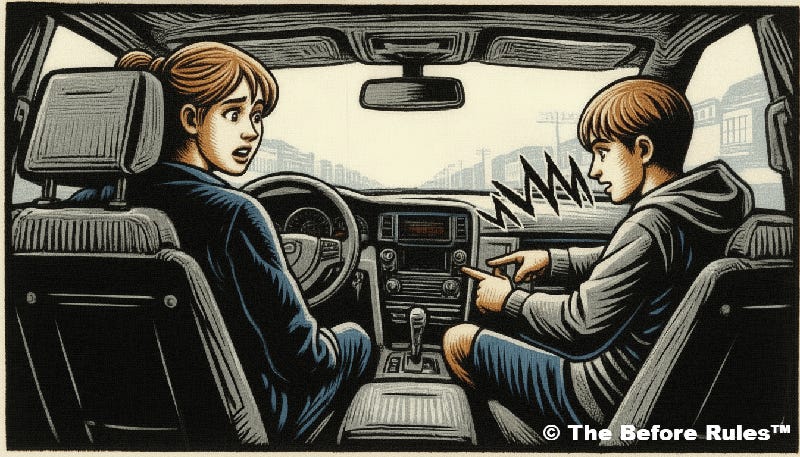
Her Car Was New: The hierarchy was not.
McKenzie Was Seventeen: Licensed, polished, and already fluent in being ahead.
McKenzie Was Perfect: Perfect grades. Perfect tennis serve. Perfect violin recital; parents always mention her skills twice because once did not seem respectful enough.
And With Perfect Social Skills: McKenzie made all her friends special.
McKenzie always said to one of her best friends, who lacked self-confidence, “How’s my ‘Sunshine’ today?”
Her other best friend, who played point guard, could pass, but rarely scored. In one game, she did make the winning basket. From that day on, McKenzie called her ‘Clutch.’
Even the two neighborhood dogs, always growling from behind the fence, had nicknames, ‘Beauty and the Bark.’
Everybody received the perfect nickname, except for her brother.
Tate Was Thirteen: And far from perfect.
Fine grades. One abandoned tennis season. Took drum lessons to compete with his sister. It ended mercifully when his parents replaced the drums with a baseball mitt.
Now in McKenzie’s new car, Tate sat in silence, being lectured like he was baggage with a pulse.
Not Nothing: She never called him by his name. Not even a nickname; not Tater, not Tat, not Tates, not Bro. Not Nothing.
The closest was an exasperated, ‘Oh, Brother.’
It had started with McKenzie saving money from her allowance and from dog-walking in the neighborhood, which led her to buy a used car.
Road Trip: She asked Tate if he wanted to go.
Even though Tate knew she wanted to show off, he went anyway.
McKenzie backed out smoothly, checking mirrors and over shoulders, driving with the precision adults admired—effortless, calm, unofficially approved.
“Don’t touch the radio. Don’t put your feet on the dashboard. If you spill anything, I will end you.”
He had spent most of his life nodding.
Two blocks later, Tate heard it.
Squeak.
Small. Thin. Coming from somewhere behind the glove box.
The car hit a road seam.
Squeak.
Tate turned his head slightly.
There it was again.
Squeak.
McKenzie kept driving.
Tate said nothing at first.
That was the family order.
McKenzie announced. Tate absorbed. Really, he conformed.
McKenzie corrected. Tate adjusted.
Squeak.
Every bump.
Every small break in the road.
Squeak.
The Sound Perfect Couldn’t Hear: Finally, Tate cleared his throat and asked, “Doesn’t that bother you?”
McKenzie glanced at him. “What?”
“That squeak.”
“What squeak?”
He immediately thought maybe there wasn’t a squeak.
She was perfect, he wasn’t. So, he said, “Nothing. Never mind.”
For now, let McKenzie stay perfect, Tate stay thirteen, and the car continue carrying both of them through the same old story.
Except this time Tate pressed, “Hit the next bump. You’ll hear it.”
Although McKenzie hadn’t heard it, she did not fully dismiss him either. Tate could feel her uncertainty.
Something in his voice had changed. He was not asking permission to be right. He was reporting from the passenger seat.
The next bump came.
Squeak.
McKenzie’s eyes widened.
The Squeak That Roared: McKenzie’s eyes moved toward the glove box.
Then toward Tate. Then back to the road.
“That’s been there?”
“Since we left the driveway,” Tate confirmed, somewhat proudly.
For a few seconds, neither of them spoke.
That silence did more than the squeak.
Tate was waiting for implicit permission to speak.
McKenzie had the license. McKenzie had the wheel. McKenzie had the new car.
But the squeak didn’t care about any of that.
The Squeak Does Not Need Permission: The squeak only needs an audience. The squeak simply needed awareness and recognition.
Unlike Tate, the squeak speaks when it wants to.
McKenzie had missed the squeak when she and her mother took the car for a test drive. Only now did she realize she needed to be more aware—and that her brother had recognized the squeak before she did.
The Squeak Was Always There: McKenzie was never aware of it.
Until Tate pointed it out.
Awareness Is Not Recognition: Awareness is the signal arriving.
Recognition is the moment you accept that the signal matters.
McKenzie recognized it.
Thanks to Tate.
And that’s how…
Tate Got A Nickname: One good thing came out of the drive. Tate got a nickname.
Finally… A nickname better than Oh, Brother.
McKenzie said, from now on, your name is…
“Squeaky.”
Tate disliked the nickname, but loved that his awareness was accepted.
And so had he.
The Value Of The Squeak: Squeaks can offer an opportunity. Even in unbalanced relationships.
The CEO needs the new hire who asks why she never visits the field offices.
The architect needs the contractor who says, “The door should open the other way.”
The doctor needs the patient who insists, “Something still feels wrong.”
And, the driver needs a passenger.
Not because the passenger knows more.
Because the passenger hears from somewhere else.
Before Rule - Awareness Before Recognition: You cannot recognize what has not first been brought into awareness. The central idea: Progress starts with noticing a signal and acting on it—first awareness, then recognition.
And sometimes the person bringing it is the one you have spent your whole life not listening to.
What Is Easy. Why Is Easy. How Is Hard: This week, think about one person with a casual relationship or with less authority than you. Ask yourself, “What squeak have you been hearing that I keep missing?”
Then do not defend.
Start With Curiosity. What Squeaks Are In Your World? Before you keep reading, name one squeak, maybe more, in your own life.
One small thing someone has mentioned more than once.
A junior employee’s concern. A boss’s concern.
A spouse’s repeated comment. Something your spouse never says.
A customer complaint, you keep calling anecdotal. But it is the tenth time you have heard it.
Become Aware: Do not solve it yet.
Simply name it.
Recognize It: All three steps are necessary; curiosity, awareness, and recognition are in that order.
Write down your awareness, then your recognition.
Note - The Gap: That space between awareness and recognition is where most problems live.
There is something wrong, but you are not recognizing it.
How To Start? Listen for the…
Squeak.
CARCAR: This essay is a component of a larger cognitive model - Curiosity, Awareness, Recognition, Creativity, Action, and Reflection; CARCAR. Two syllables, same sound, easy to remember.
It starts with Curiosity Before Awareness, followed by where we are now, Awareness Before Recognition .
Learn more about CARCAR and other Before Rules.
Sing-Alongs Welcomed: The essay provides a framework for your mind. This short video gives your body the beat. You give the idea its spark.
Most everything you need to (know) hear.
AI-Generated Music © The Before Rules™
You’ve Read The Book, Now See The Movie
© The Before Rules™
Before Rules: Laws are written for you. Rules are created by you.
The Before Rules are three-word systems for achieving real outcomes by putting the right thing first. Built on the sequence Here | Before | There, they clarify what must come first so progress becomes actionable, repeatable, and real. Examples include: Deposits Before Withdrawals, Through Before To, and Obstacle Before Opportunity. Visit BeforeRules.com to learn more.
Your Thoughts May Vary: The Before Rules welcomes your constructive comments and invites you to share your perspectives and experiences. Together, we can all refine our understanding and application of these concepts.
Disclaimer: Click here for our Disclosures, Disavowals, And Declarations (aka - I told you so).