

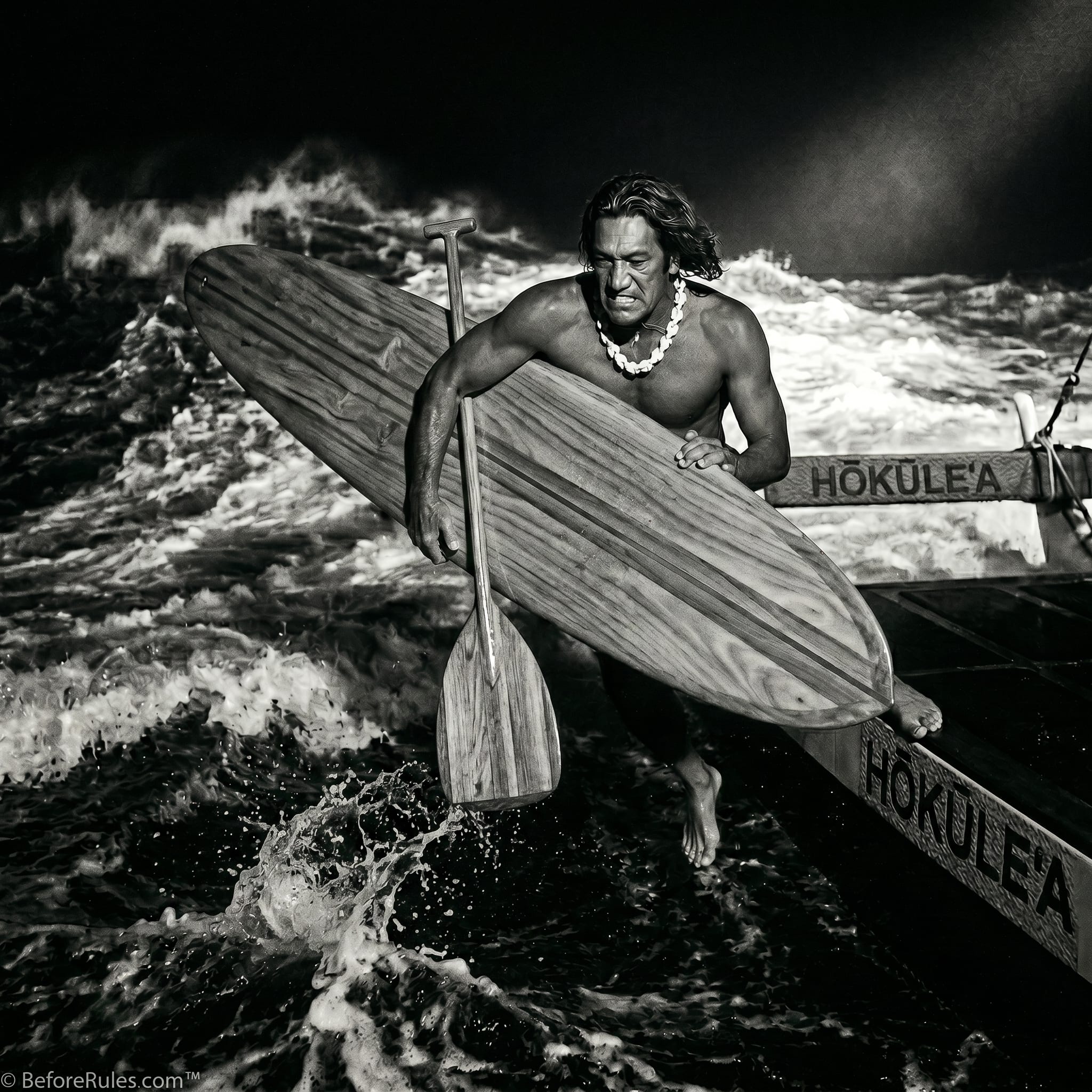
The Hōkūleʻa: Twelve miles offshore from Hawaii. What was a canoe doing in the middle of the ocean? During a storm? On purpose? Sinking?
Eddie Would Go: Eddie’s paddle did not save the crew. A flare did.
The slogan got the verb right. It got the reason wrong.
You’ve Seen It: If you have spent any time near an ocean with surfers, you have seen the sticker, “Eddie Would Go.”
Beach Mantra: The slogan was everywhere—on a kid’s hoodie, a surfboard, a coffee mug belonging to someone who didn’t know the story, and on countless surfers’ bumpers.
The phrase has become shorthand for a certain kind of courage. The kind that says ‘yes’ when everyone else says ‘wait.’
That is not what the phrase meant when it was born.
And it is not why Eddie went.
Let’s start at the beginning…
Five Hundred Rescues. Zero Deaths. And Nobody Photographed: In 1968, Eddie Aikau became the first official lifeguard at Waimea Bay. He worked the bay through the winters of the late sixties and the seventies — winters when the wave faces routinely 20 to 30 feet, when the rip currents could pull a strong swimmer half a mile out before anyone could react.
Twenty Feet: Imagine lying on your stomach in front of a two-story building, looking up. Now imagine that building is a moving wall of water, crashing down on you. That’s 20 feet.
Add another story. That’s 30 feet.
500 - A Perfect Record: Between 1968 and 1978, Eddie made over five hundred rescues. Not one person drowned on his watch.
The lifeguard captain warned his guards, “Don’t risk your own life when the waves get too big. Call for a helicopter. Wait it out.”
Eddie Went: Eddie did not wait.
Exasperated, the captain joked, “Even if I chained him to the tower, Eddie would still go.”
The phrase “Eddie would go” was born in those years, not after them. That is the actual birth of the phrase.
What Began As A Complaint Transcended Into A Slogan: It wasn’t just a nickname or a catchy phrase, but a declaration of character: “Eddie would go.” It was this complaint that became the slogan.
An affectionate, slightly desperate description of a quiet man whose nerves were trained by endless repetition to do one thing when someone was drowning.
The decision was ingrained. If a person needed help, Eddie would enter the water.
The Theory Many Experts Doubted. Did Polynesians Really Open Ocean Canoe To Hawaii? Experts said it was possible, but unlikely. Too far. Unsafe. How would they navigate?
The Polynesian Voyaging Society launched the Hōkūleʻa — a sixty-foot double-hulled canoe — from Honolulu, bound for Tahiti.
The purpose was to test the theory, the canoe construction, the navigation, and… the distance.
Why Hōkūleʻa? Hōkūleʻa is the Hawaiian name for Arcturus, a brilliant star with immense navigational importance. It passes directly overhead at Hawaii’s latitude—a “zenith star.” For ancient Polynesian voyagers, seeing Hōkūleʻa overhead meant they were close to home. Hōkū means star; leʻa means gladness: the star of joy.
2,700 Miles/3,200 Miles: In March 1978, Eddie Aikau, then 31, boarded the Hōkūleʻa as the sixteenth crew member.
The Hōkūleʻa was a Polynesian voyaging canoe bound 2,700 miles for Tahiti, about the distance from Seattle to Miami. That is, if the voyage were a straight line.
But with tides, winds, currents, storms, and unknowns, the journey stretched closer to 3,200 miles—about the distance from Seattle to Jamaica.
Thursday, March 16, 1978, around 7:00 PM: The departure ceremony honored the canoe and her crew. It also contributed to the decision to depart that evening — despite bad-weather warnings.
Shortly after midnight, the Hōkūleʻa capsized. The crew clung to the overturned hulls in the dark, drifting in twenty-foot seas and gale-force winds, with no working radio.
Flares were fired. No one saw. No one was looking.
The canoe drifted farther from the shipping lanes.
Eddie Quietly Knew: While the crew was frantic — loud with fear, loud with the question what do we do?
Eddie had already arrived at an answer.
By his reading, the only chance his crew had was for someone to paddle for help.
That someone was him. Twelve miles, maybe fifteen by then, through open Pacific, to Lana’i.
On a surfboard.
Alone.
A Choice Follows A Current. A Decision Sets The Heading: Eddie told the captain of his decision.
Eddie Would Not Go: The captain refused. Twice.
Then he conferred with the navigator and officers, and the decision came back in three words.
Eddie would go.
He strapped on a life jacket, grabbed his board and paddle, and pushed off from the canoe into the open Pacific. His crewmates watched him disappear.
He was never seen again.
The Thing That Saved Them Wasn’t Eddie: Twelve hours later, a Hawaiian Airlines pilot caught the flicker of the canoe’s last flare out of the corner of his eye.
The Coast Guard reached the crew at one in the morning. Fifteen survivors. One missing.
The Man Came First. The Sticker Came Later: The search for Eddie became the largest air-and-sea operation in Hawaiian history. They never found him.
The storm did not make the decision. It only confirmed what already existed within.
What The Bumper Sticker Doesn’t Say: Eddie’s attempt to reach shore didn’t save them. The flare did.
His death turned out to be, in the cold language of outcome, unnecessary.
Sit with that, because many would see that outcome as the problem.
It’s Not The Outcome: Eddie did not paddle into the dark because he calculated the odds. He paddled because the calculation had already been made — not that morning, not when the mast cracked, or when the canoe overturned, but across five hundred quiet rescues nobody photographed, in the small waves before the big ones, in the years nobody was watching.
Except him.
That is the Before Rule he lived without knowing its name.
The storm did not make the decision. It only confirmed what already existed within him.
Decision Before Choice: You don’t become brave in the moment of adversity. You become brave in the calm, in the years before the storm. The choice is only what the storm reveals. The decision is your action.
When your decisions are without exception, they aren’t virtues. They’re command codes.
You become brave in the years before the wave—in the times nobody photographs, in the slow work of becoming someone whose decisions are made long before the moment arrives.
A choice is what you do when your back is against the wall. A decision is why your back never gets there.
Decision Before Choice sounds like it removes your freedom.
It is actually the only way to protect it.
What Happened to the Hōkūleʻa? After Eddie was lost, the Hōkūleʻa did not quit. They could have. Instead, they did the quiet work — the training, the wayfinding, the years of reading stars and swells before the canoe touched water again.
In 1980, the Hōkūleʻa sailed to Tahiti and back without instruments, a return crossing the Polynesian Voyaging Society says had not been done in 600 years.
That is the quiet sequel to Eddie’s story. The 1978 voyage had courage, ceremony, and willingness. The 1980 voyage had all of that — and the decision that the first one was missing.
The first crossing showed what courage would choose. The second showed that a decision had already been made.
What Happened To Eddie: Hawaii made the legend before any brand did. From 1985 to 2016, the big-wave contest at Waimea carried a corporate name in front of his. By 2024, it carried Eddie’s name alone again — the way Hawaii had carried it from the start.
Choices Are Revealed In The Storm. Decisions Are Made In The Calm Before It.
Choices Are Loud: They urge us to try harder, to do more, to push against whatever is in front of us. But decisions are quiet—they ask us to step back and see where the real obstacle lies.
Decisions Are Quiet: Effort without discernment, without decision, becomes wasted motion. Wisdom is deciding where your energy matters most—and letting your decisions create the menu of meaningful action.
So, What’s Your Decision? Not the one you’ll make when your storm arrives — and it will.
The one you’re making right now, when nobody is watching.
Except you.
Sing-Alongs Welcomed: The essay provides a framework for your mind. This short video gives your body the beat. You give the idea its spark.
Most everything you need to (know) hear.
AI-Generated Music © The Before Rules™
You’ve Read The Book, Now See The Movie:
Before Rules: Laws are written for you. Rules are created by you.
The Before Rules are three-word systems for achieving real outcomes by putting the right thing first. Built on the sequence Here | Before | There, they clarify what must come first so progress becomes actionable, repeatable, and real. Examples include: Deposits Before Withdrawals, Through Before To, and Obstacle Before Opportunity. Visit BeforeRules.com to learn more.
Your Thoughts May Vary: The Before Rules welcomes your constructive comments and invites you to share your perspectives and experiences. Together, we can all refine our understanding and application of these concepts.
Disclaimer: Click here for our Disclosures, Disavowals, And Declarations (aka - I told you so):