

We've all heard of shooting stars, the celestial objects that blaze through the night sky for a short amount of time before disappearing. In many ways, shooting thoughts are like this: there, just for a moment, gone the next. But how do we capture and harness these fleeting thoughts?
Audio In, Synthesis, Creativity Out: In this article, I will discuss a method to allow you to create and capture shooting thoughts. I'll show you a simple system to create and capture thoughts, ideas, insights, etc., and convert them into ideas. I will discuss the structure, the process, and the outcome of becoming aware, recognizing, and capturing your creative thoughts - as they occur. I have tinkered, failed, adjusted, reflected, and improved this process for more than a decade.
Questions Before Answers
What’s a shooting thought?
How can I be ready to catch shooting thoughts?
How can I become more creative by creating shooting thoughts?
Brief Overview
Audio In, Synthesis, Creativity Out: This is a simple system to create, spark, capture, and synthesize thoughts, ideas, insights, etc., and convert them into ideas.
Audio In: Begin by choosing a focal point — in this example, willpower — and pool a variety of resources around this topic. Then, fully immerse yourself in relevant audio content from platforms like YouTube, Audible, podcasts, TED Talks, and more.
Synthesis: When you listen to the audio, your mind coalesces and synthesizes this new information with your existing knowledge and wisdom.
Creativity Out: Your newly synthesized ideas and thoughts are voice-recorded into an open Google Doc file.
Walking The Walk, Talking The Talk
These Thoughts Are Made For Walking: I walk every morning and save my ideas and thoughts. You can also use the same system as you hike, sit, relax, or work out on a stationary treadmill or spin biking. This method is not recommended if you are actively moving, such as driving, running, or outdoor biking.
Creativity involves paradox. Here is the first paradox of creativity.
“The opportunity of a lifetime must be seized within the lifetime of the opportunity.”
What Is A Shooting Thought? Shooting thoughts are the shooting stars in our mind — brief and frequently sparking insightful or brilliant moments of creativity and ideas. They are unexpected and often unrelated to what we are doing, working on, or thinking about at the very moment.
A Thoughtful Warning — Fast In, Faster Out: Both shooting stars and shooting thoughts arrive unexpectedly and disappear just as quickly. You need to stay alert and prepared to seize the moment.
How To Have More Shooting Thoughts: While catching a shooting thought is valuable, how much more powerful would it be if you could actively create shooting thoughts instead?
What’s The Best Way To Have A Good Idea? According to Linus Pauling, “The best way to have a good idea is to have a lot of ideas.”
How To Create A Shooting Thought
The Shooting Thought Formula — The Creativity Cycle: Here is your simple system for creating and catching shooting thoughts and ideas anytime.
The Structure — The Creativity Cycle
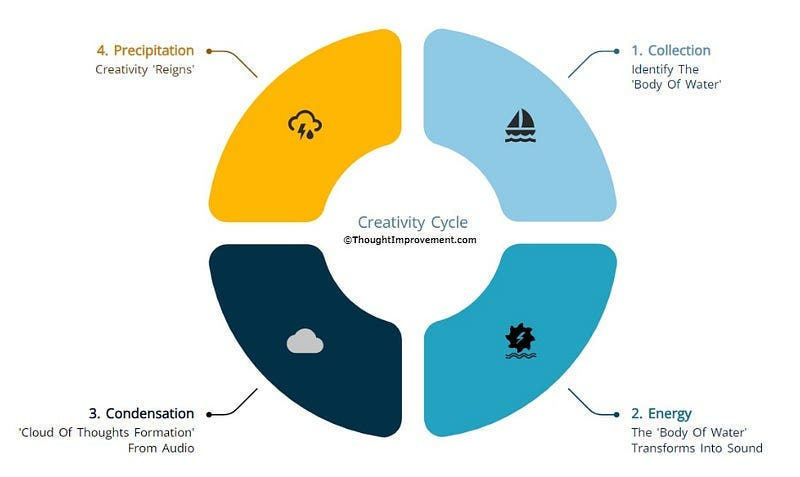
Similar To The Cycle Of Water: The Creativity Cycle is a systematic process to identify a topic, conceptualize it, process it, record it, and begin again. Imagine the water cycle, except the application is for your thoughts, ideas, creativity, etc.
The Structure — The Creativity Cycle— Steps
The Source: I will use audio files as an example throughout this discussion, but it can be any collection of content in any format.
How Is The Creativity Cycle Similar To The Cycle Of Water? Like the water cycle, the Creativity Cycle follows a simple four-step process.
1. Collection — Identify The ‘Body Of Water’: The Creativity Cycle starts by recognizing and accumulating the desired subject you wish to explore — your reservoir of information. It’s identifying and gathering from the ‘pool of information’ you select. Your pool is a source of specific playlists of topics such as willpower, procrastination, habits, recipes, historical events, audiobooks, etc.
Lake Willpower, If You Will…: We will continue using the willpower example in this essay. In our case, your smartphone holds the audio files regarding harnessing willpower, serving as our body of water.
2. Energy — The ‘Body Of Water’ Transforms Into Sound: Your thirst for knowledge and desire to learn and understand is the energy that captures the audio information through your headphones, causing it to transform — much like water vapor — into audio waves, which then help to form the foundation for your ideas.
3. Condensation — ‘Cloud Of Thoughts Formation’ From Audio: Just as in the water cycle, after water vapor rises, condensation occurs, and then clouds form. Your audio playlist is cognitively analyzed and processed, mixing, mingling, and merging into your existing knowledge. This interaction increases understanding, comprehension, and awareness of your selected topic: willpower.
4. Precipitation — Creativity ‘Reigns’: The fourth step happens as these new insights merge with your existing knowledge. This synthesized information completes its cycle from information to knowledge to creativity. Essentially, your new ideas from your clouds of knowledge, are ready to rain — or in this case, to be voice-recorded into your smartphone. Creativity downpours from your mind and is then recorded.
Rinse And Repeat: These droplets of information become part of your knowledge base, your body of water, prepared to initiate the Creativity Cycle repeatedly. Each time, the new, added data and the new, added information merge with your existing knowledge base, increasing your wisdom, ideas, and creativity.
Now that we understand how the Creativity Cycle works, let’s delve into…
How Do You Catch A Shooting Thought?
Immediately! The key to catching a shooting thought is to act swiftly! As soon as you encounter something intriguing, informative, valuable, or insightful that sparks an idea, immediately record your thoughts into a specific Google document.
“If you don’t execute a great idea, it dies an unnecessary death.”
Fast Thought: When I hear something interesting, educational, valuable, worth exploring, or insightful, or if the audio creates a spark of an idea, I immediately dictate my thought directly into a specific Google document.
The Process Components
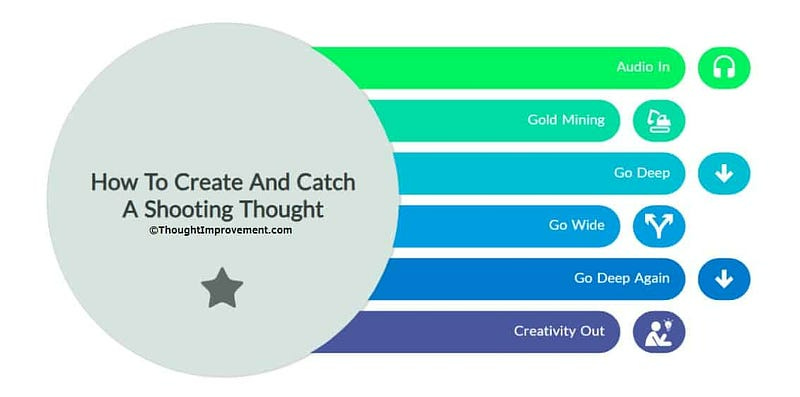
The Process Step 1 — Audio In, Creativity Out
Immersion — Easy Victories: Listening to audio and recording your creative ideas works great when walking, hiking, riding a stationary bike, or using a treadmill. Easy victories often amplify the sweetness of success.

Band On The Run: This is how the Creativity Cycle works at this stage. Use an armband to connect your phone to your body, stationary bike, or treadmill. If you are walking, instead of placing the smartphone armband on your bicep, place it on your wrist. I simply move the armband to my wrist because it is easier to access quickly.
Bonus Tip - Brain.fm: Each time I start my walk, I use Brain.fm app to boost my creativity. This AI-powered music service is crafted to enhance focus, relaxation, and sleep. By synchronizing with your brainwaves through a process called neural phase-locking, Brain.fm offers specially engineered music that harmonizes with your brain's natural rhythms. It's an evidence-based method to elevate cognitive performance and mental well-being.
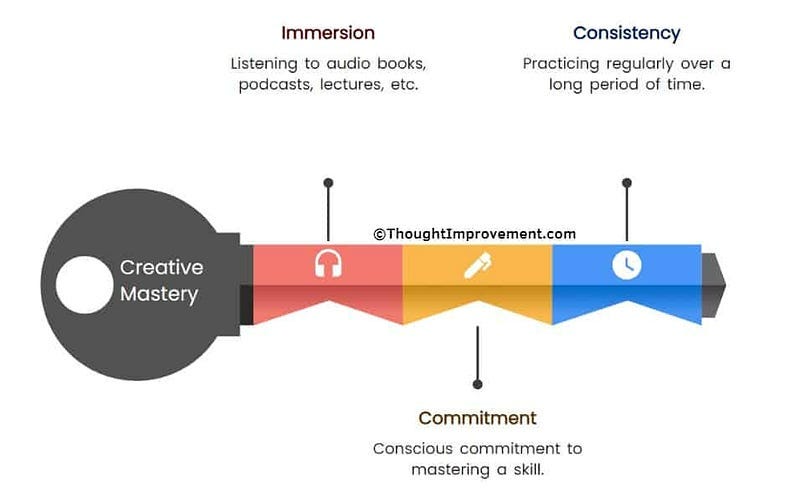
Developing Consistency: Consistency means practicing regularly over a long period of time. While there are no shortcuts to creative mastery, easy victories are along the path to travel.
Combining Commitment: Commitment involves means making a conscious decision to dedicate yourself to creative mastery (creativity is a skill that can be taught, learned, improved, and mastered). Commitment becomes more enjoyable and easier when you combine commitment with something you are already doing — in this case, working out. When you simply add listening to audio during your normally scheduled workout time, commitment becomes another on the list of easy victories.
“Creativity is connecting things that seem unrelated.” — Steve Jobs
Creativity Is Connecting Your Thoughts: Catching your shooting thoughts results in having more ‘dots.’ The more dots you have results in, the more possible connections. The greater number of connections you have, the more creative you become.
Creative Mastery: Many people believe that creativity is random sparks, presenting only when the spark decides to ignite. But creativity is a skill that can be taught, learned, improved, and mastered so that you create the sparks, and you control the ignition.
Creativity Is Like Water: Creativity is just as formless as water; it simply awaits guidance, or a shape, or a structure to direct and shape and direct its power.
The Flow Of Creativity: Imagine a powerful river cutting its path to the ocean. The river is the flow, the force and energy to be directed. The river banks are the structure that channel and coalesce the flow into an unstoppable force.
The Paradox — Structure Creates Freedom: Ironically, if you desire unbounded creativity, the structure you apply creates your freedom.
Structure Catches Shooting Thoughts: If you want to be creative, apply the structure of this article to catching your own shooting thoughts.
“The best way to have a good idea is to have lots of ideas.” — Linus Pauling
The Process Step 2 — Mining
The Creativity Cycle Is Essentially Gold Mining: When you mine for gold, you have to explore and identify the land, process the raw material, then screen and separate the material from the gold.

Not Everything Has Value: In gold mining, a capture rate of at least two ounces or more per ton of material processed is considered a minimum for many operations. Two ounces of gold per ton, which equates to just 0.01% of everything processed, has tremendous value. You have to process the material effectively and efficiently.
“Gold is where you find it. But you have to look in the right place.”
Seeking Nuggets: You are seeking those creative nuggets. You may process and learn a lot of information.
Finding Gold Flakes: Sometimes, you don’t find the large gold nuggets you are seeking. You may find many smaller flakes of ideas. You soon determine that whether flakes or nuggets, it is all gold. You combine your ideas, insights, and thoughts and create another nugget.
Turning Flakes Into Nuggets: One way to organize and combine the gold flakes is to tag them. I might have an idea that has potential, but I’m not sure at this very moment about how to use it. I simply do the following; I state the concept of the idea — for example, #Creativity — then I also add the base hashtag #HowCanIUse.
When I’m ready, I simply go through my notes and search for the hashtags. I have hundreds and hundreds of #HowCanIUse tags throughout my notes. Many may never be used. It’s akin to going to your local grocery store to buy cheddar cheese and seeing feta cheese on sale. You may wonder #HowCanIUse #FetaCheese, which is something you can dictate and store for later.
The Process Step 3 — The Go Deep, Go Wide Immersion Technique
Go Deep
“Why do you rob banks? Because that’s where the money is.” — Willie Sutton (Although the quote is often attributed to the infamous American bank robber, it’s more likely created by a journalist.)
The Willie Sutton Strategy: Just like Willie Sutton supposedly targeted banks because that’s where money was. He asked himself, “Why look all over town when you go to just one place, the bank, your bank, and find what you want — and lots of it?”
Be Like Willie? Aside from possible jail time, consolidating your efforts at the bank is a great strategy. You can use a similar approach to finding creative thoughts.
How Do Thoughts Enter Your Mind?: Focus on concentrated learning by researching a desired subject, then gather your best ideas in one place so you can easily find and access them.
Immerse Yourself: You assemble quality information about your desired topic and immerse yourself in the content.
Immersion Formula — Go Deep, Go Wide: After selecting the topic of willpower, I next go to Audible and identify books. I start with Audible because I want a deep understanding of the topic. In this example, I found several with stellar reviews, and each audiobook was typically 5–9 hours long. Since I listen to these resources about an hour a day while walking, this creates a substantial working foundation for a week or two.
Digging Deeper: I identified many books, including these two:
Title: Willpower — Rediscovering the Greatest Human Strength
By: Roy F. Baumeister, John Tierney
Length: 9 hrs and 6 mins
Title: The Willpower Instinct: How Self-Control Works, Why It Matters, and What You Can Do to Get More of It
By: Dr. Kelly McGonigal
Length: 8 hrs and 20 mins
(I bought and enjoyed both of the above books. These two links contain an affiliate link which may result in a commission.)
Why Do I ‘Go Deep’ First? The author Kelly McGonigal has a Ph.D. from Stanford and has been featured in TED Talks. What better place to start? I wanted to hear her analysis and understanding of willpower from the basics to validating and research studies. Going deep provides a broad framework and knowledge for me.
Go Wide
Going Wide: After my deep plunge, I am conversant on willpower. And I am ready to broaden my knowledge further. Going wide incorporates the concepts of deliberate practice. Deliberate practice involves structured and focused efforts to improve performance by targeting weaknesses and pushing the boundaries of one’s current abilities.
Going Wide — The Author: Next, I go to YouTube and find 10+ podcasts and lectures with the author of the Audible book.

Why So Many Author Interviews? I select at least ten videos because interviewers or podcast hosts will ask different questions. Additionally, the author may give longer or more thorough answers or use other examples. This enhances my knowledge.
Going Wide — The Topic: Next, I search for directly tangential information on willpower, such as TedTalk lectures, college professors, and other notable experts in the willpower field.
Why Go Wide? Different experts will have different opinions, theories, beliefs, and ideas. I want to challenge what I learned by going deep and augmenting my knowledge.
Go Deep Again
I Listen To The Audible Book Again. Why? I Repeat — Why? This step is based on the concept of spaced repetition. Spaced repetition is a learning technique that involves reviewing and revisiting information at specific intervals over time. The main idea behind spaced repetition is to retain information in your long-term memory. It is based on the observation that the brain remembers information better when it is encountered repeatedly at spaced intervals rather than in rapid succession. This second listening employs the learning technique that involves reviewing information at various intervals over time to enhance long-term retention and understanding.
Competing Signals: Growing up, in a time before cable (hard to believe there was such a time) and while living near an Air Force base, I came to learn about competing TV signals. A plane would fly overhead, and the TV signal would hit our rooftop antenna, then a second later, the same TV signal would bounce off the airplane and down to our antenna again. We received two signals of the same broadcast, just a second apart, causing us to interpret the TV show differently, and forcing us to be creative in analyzing what we missed.
Audible — Honing in on the Signal: By listening to the Audible book again, usually two to five weeks after hearing it for the first time, I heard many, many subtle comments that I just missed during my first hearing. I am receiving two signals, at different intervals, and this causes me to think about the topic differently. I was now more knowledgeable about willpower from this author and other experts.
A Conceptual Summary: Creative mastery requires three skills:
Immersion: This means surrounding yourself with the skill or topic you are trying to master. In this essay, you achieve immersion by listening to audiobooks, podcasts, lectures, etc.
Commitment: Commitment means making a conscious decision to dedicate yourself to mastery. This means scheduling time, at regular intervals, to practice. This step becomes easier when you combine commitment with something you are already doing, working out.
Consistency: Consistency means practicing regularly over a long period of time. While there are no shortcuts to creative mastery, there are easy victories to achieve.
The Process Step 4 — Thought Banking
“The faintest ink is better than the strongest memory.” — Chinese Proverb
Thought Banking: I started a rudimentary version of this system around 2007, shortly after Google offered its document feature Google Docs. I simply created a file called ‘Shooting Thoughts’ and deposited my ideas via dictation. It has continually evolved and improved.

That’s A Lot Of Banks: Whenever I complete approximately 50–125 pages of thoughts, ideas, things to look up, etc., captured in my Google document, I create the next vault. This thought banking method now has multiple branch locations. My latest storage document is creatively entitled ‘Shooting Thoughts #33.’
What Next?

How To Implement: Here is just one example. Can a stroll on your favorite beach result in your next creative breakthrough?
How can you transform your next beach walk into your most brilliant and insightful brainstorming session?
Discover the simple, insightful, step-by-step process for harnessing the power of your favorite beach and the secrets to capturing your brilliant yet fleeting thoughts and ideas while enjoying the ocean and the sun.
This Has Been The Shooting Thought System v.15: I still refine and improve my method and system as soon as needed. I typically add a few minor improvements a month. Most of the recent updates I have created now involve using additional external actions to refine my inputs into Google Docs. The version you are now reading is v15.
The Shooting Thought System v.17: I am just completing v17, which is a significant process upgrade. It incorporates a more robust and comprehensive technique to create and capture ideas. It includes ways to integrate and refine research while recording your thoughts.
I present a method to catch your shooting thoughts when you are doing any physical motion, such as running or biking. The next upgrade includes software suggestions to simplify the recording of creative ideas, software to maximize your thoughts and ideas from the Audible books and podcasts, a simplified indexing system for processing creative ideas, evidence-based research on the role of music and sound in stimulating the creative process, the current structure and exact template I use, and more.
Click here to request more information on how to access the latest “How To Create And Catch A Shooting Thought” update.
Thoughtercise
When do you think you’re most creative? Is there a way that you can easily record your thoughts during this time?
Is there something you’re interested in learning more about but haven’t found the time to do it? Perhaps listening to an audiobook while working out could be your key to getting in the door.
What are three specific topics that interest you right now?
You’re Ready to Catch Shooting Thoughts!
Thought Points — Four-Step Summary: Let’s reinforce this creativity process to ensure you get the most out of your own thoughts:
Audio In, Creativity Out: Select an area of focus. Choose highly-rated and informative sources (audiobooks, TED Talks, lectures, etc.) to listen to. Have an audio recorder (like a smartwatch or smartphone) of your choice available to record your thoughts.
Mining: Go through your recorded thoughts and pick out the best ones (gold nuggets), or ones that might have future value (gold flakes) when combined with others.
The Go Deep, Go Wide Immersion Technique: Find other related resources that can help you gain an even deeper and wider understanding of your chosen topic.
Thought Banking: Set up a Google Doc or similar document where you can bank all your best thoughts, ideas, and revelations.
Your Thoughts May Vary
Thought Improvement welcomes your constructive appreciation comments and invites you to share your perspectives, ideas, and suggestions. Together, we can all improve our thoughts.
Click here for our Disclaimers, Disclosures, Disavowals, And Declarations (aka - I told you so).