

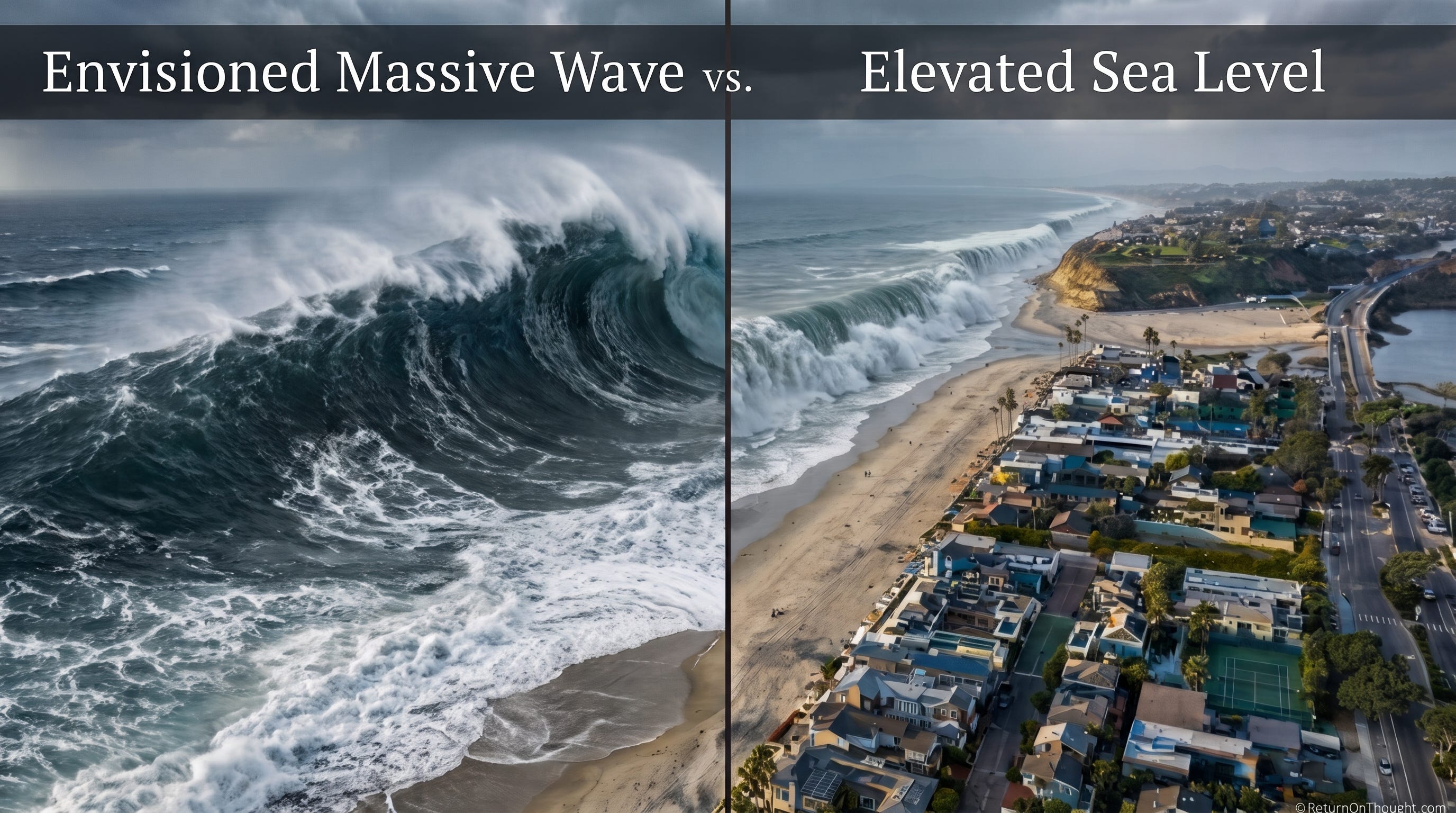
Overly dramatic AI-generated image of Del Mar Beach. How some people may envision rising sea levels, as if experiencing a single, large, tsunami-like wave. A Kelvin Wave can produce an elevated wall of surging seawater. (Courtesy of © ReturnOnThought.com™)
Your tide chart is almost correct. But it forgot something—something it couldn’t have known. The other factors. There’s a bunch… and, that’s the problem.
Let’s back up a bit…
Surf Check: I remember a simpler time. I’d check my tide guide (the calendar, not an app), pick a beach based on when I could surf, and go.
Low Tide: 15th Street, Cardiff Reef, Swami’s.
High Tide: Black’s Beach to Torrey Pines. Seaside, Tabletops, and, depending on the tide, the Jetty at Carlsbad.
Super High Tide: Sometimes, I’d Consider Terramar—just for the rebounding wave that ricochets off the bluff and hits the incoming wave. (I once had an out-of-body experience there.)
After studying tides, reviewing options, and driving up and down the coast from La Jolla to Oceanside for an hour, I’d almost always end up surfing at Beacon’s.
2026: But then my tried-and-true surf check system began to fail—not because it stopped working, but because new variables entered the picture.
In late October in Oceanside, local news showed the ocean coiled around a lifeguard tower like a python devouring prey. In Mission Beach, a man paddleboarded to his driveway. Huntington Beach declared an emergency. PCH closed.
And the Long Beach Peninsula—or, as it’s now called, the community “Formerly Known As The Long Beach Peninsula”—took a direct hit. Waves pummeled waterfront homes daily.
King Tides? El Niño? Kelvin Waves? Ocean Warming? Storm Surge? Coastal Development? Sand Choking? A Little Background: What’s going on?
King Tides—His Royal High Water: King Tides are the highest predicted tides of the year, caused by gravity—the Sun, the Moon, and a slightly closer orbit all align. Gravity lifts the ocean, creating a bulge: the high tide.
The closer the Moon, the higher the tide.
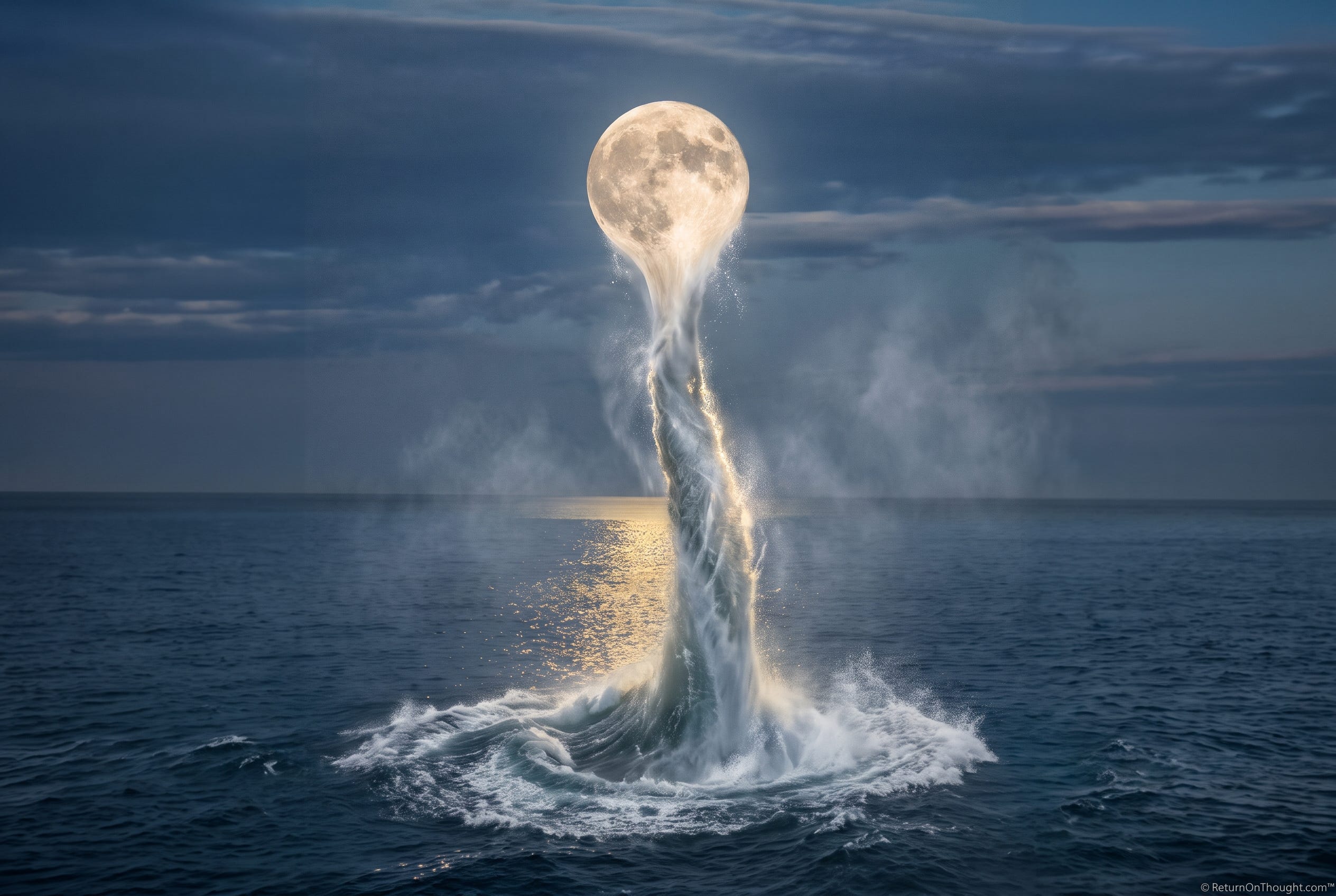
Overly dramatic AI-generated image of the gravitational impact of the Moon on the ocean, elevating sea levels and resulting in King Tides. (Courtesy of © ReturnOnThought.com™)
El Niño—Like A Giant Game of Pong? Imagine a massive blob of warm Pacific Ocean water bouncing from Asia to South America and back again. It’s so huge it shifts weather worldwide.
This irregular seesaw between warm, cold, and neutral states across the tropical Pacific occurs on average every 2 to 7 years.
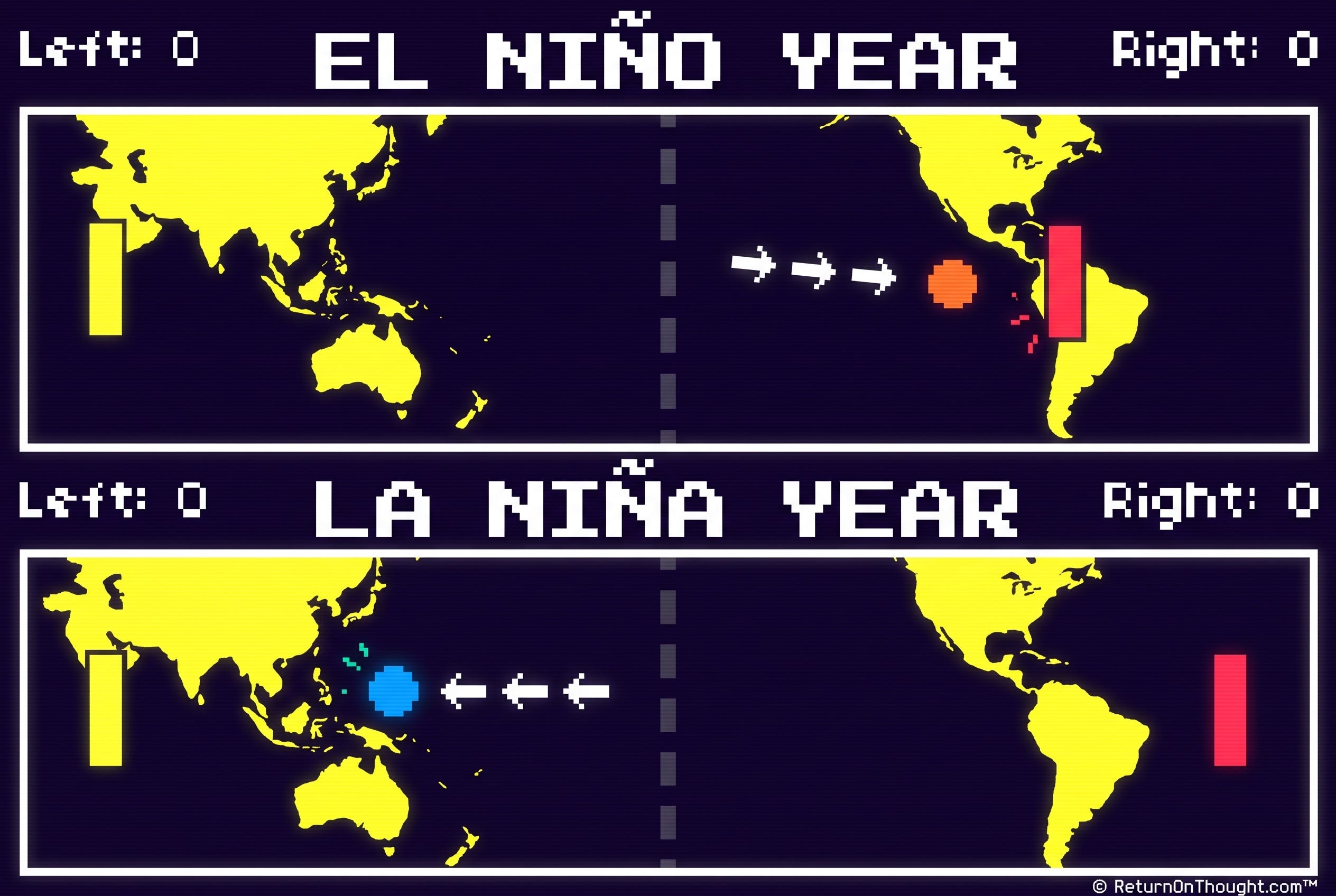
Overly dramatic AI-generated image of the El Niño–Southern Oscillation appearing as if it is a giant game of Pong. (Courtesy of © ReturnOnThought.com™)
What Happens In Peru Doesn’t Stay In Peru: Now some people are asking, isn’t El Niño a Peru problem?
Well, it starts there. It doesn’t stay there.
Kelvin Wave… A Wave With No Wave: A King Tide sounds royal. A Kelvin Wave sounds like a slacker. It’s not. It is a home wrecker.
You learned the physics at age four, in the bathtub: push water toward the far end, and when it has nowhere else to go, it rises, then runs sideways, hugging the porcelain.

Overly dramatic AI-generated image of a toddler causing a Kelvin Wave. (Courtesy of © ReturnOnThought.com™)
The Pacific does the same thing against South America. The bulge splits, and half of it runs north along the coast — Mexico, then Baja, then us.
That bulge is a Kelvin Wave. It takes weeks to reach SoCal from South America. It doesn’t break. No one rides it. Drone footage would look like a parking lot—featureless and slow.
An Inch? Some scientists predict a Kelvin Wave can cause an ocean rise of an inch or two; others say a foot or more.
When An Inch Is Not An Inch: An inch doesn’t sound like much until it is an inch of seawater on your living room floor.
And, not surprisingly, it comes in waves.
A Kelvin Wave lifts the entire sea.
More Than An Inch: For two weeks in October 2026, the La Jolla tide gauge measured tides about a foot and a half above what the chart predicted. The tide cycles didn’t change—the Kelvin Wave elevated the whole ocean, and the already-high tides with it.
Ocean Warming? Not surprisingly, when water warms up, it expands.
I heard “trunking it” (surfing without a wetsuit) more times this year than in the past decade. It used to be a badge of honor for a month or two each year. This year, it’s lasted six months.
Yeah, it was that warm.
Storm Surge? During wind events, sea level rises even further. Offshore, hurricane remnants can add another foot, or two, or three in Southern California. Or as our friends in Florida and the Gulf Coast would refer to it: ‘wimpy.’
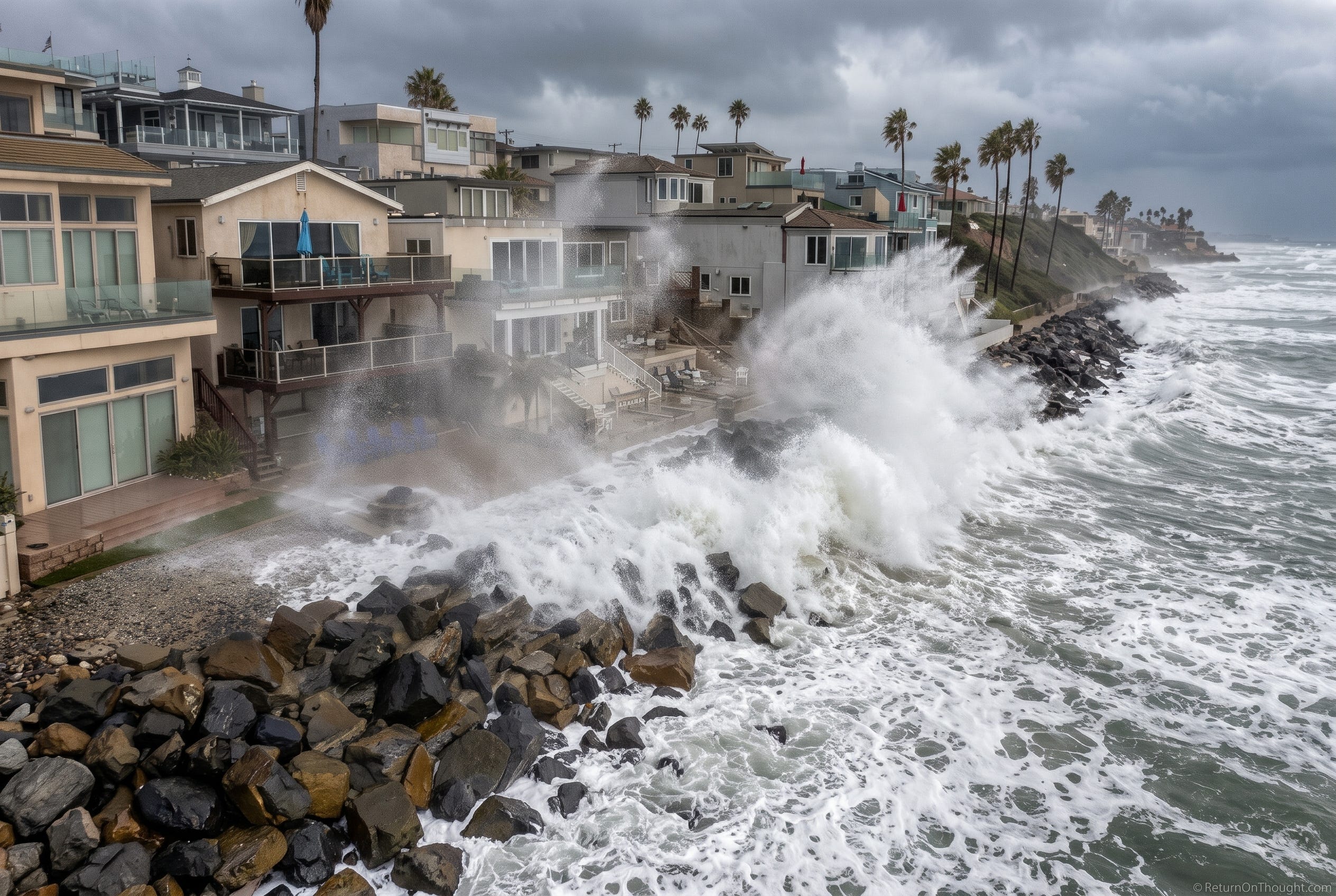
Overly dramatic AI-generated image of oceanfront Oceanside, California, homes experiencing a storm surge. (Courtesy of © ReturnOnThought.com™)
Coastal Development—The Concrete Trap? Our coast survives massive tides by rolling backward and letting water flood into natural wetlands. Instead of giving the ocean room to breathe, we pinned it down with railway lines, coastal highways, and cliff-top estates. As if that wasn’t enough, we armored the bluffs with vertical seawalls and rock rip-rap. But flat concrete doesn't absorb wave energy—it reflects it directly back into the surf, scouring away whatever sand is trapped at the base.
Sand Choking—The Sand Faucet We Turned Off: Just where does our sand originate? Historically, 80% of our sand washed down inland rivers during flash floods, while the rest came from bluffs that crumbled. By damming rivers, paving watersheds, and capturing debris upstream, we shut off that natural pipeline. We starved the shoreline from behind, watched the protective buffer vanish, and now act shocked when an eight-foot tide finds nothing to hit but bare rock.
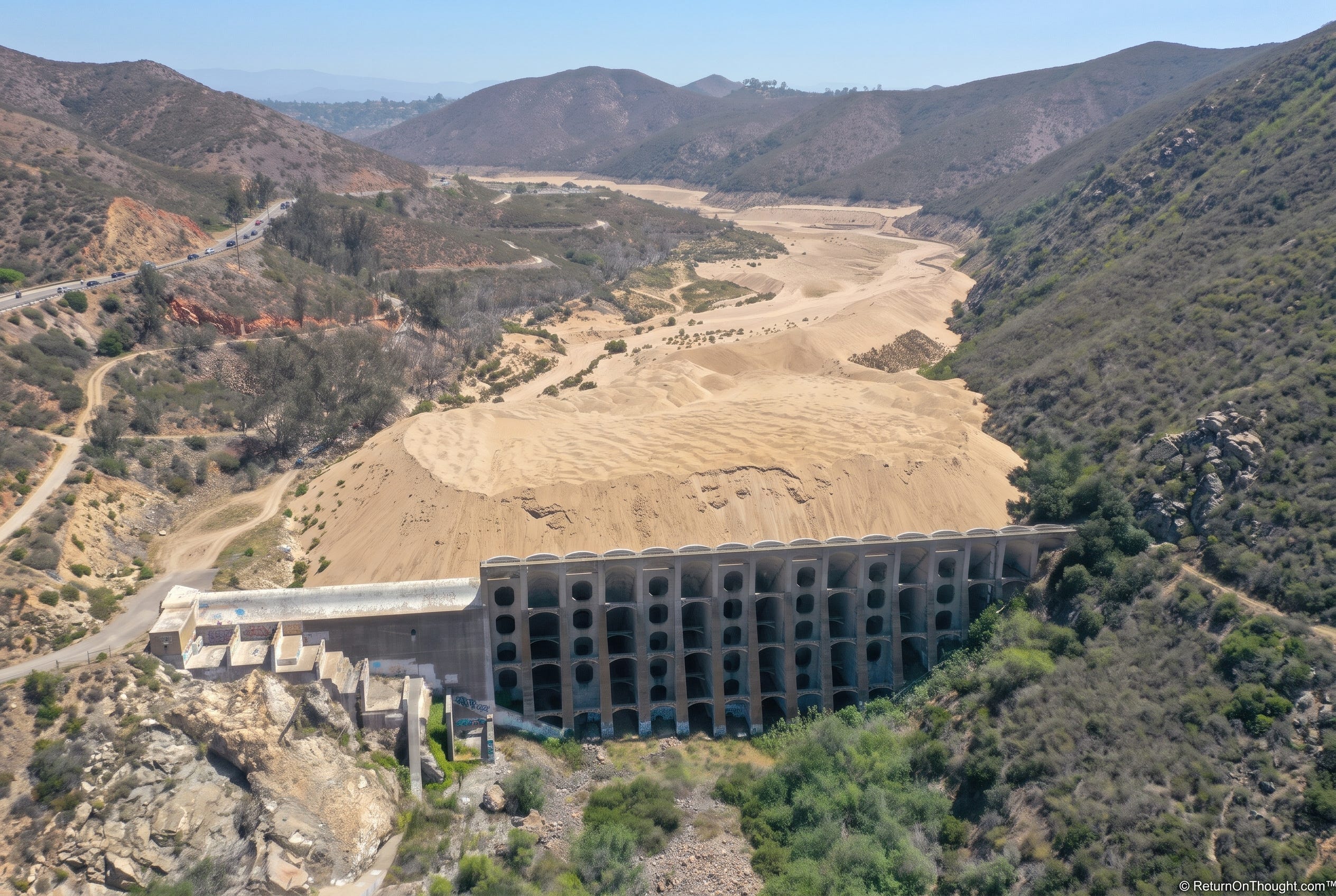
Overly dramatic AI-generated image of Lake Hodges preventing sand from reaching beaches. (Courtesy of © ReturnOnThought.com™)
OK, Maybe That Was Just Bad Luck. It Couldn’t Get Any Worse, Could It? The tide guide predicts the next set of King Tides don’t start until the 24th, right before Thanksgiving.
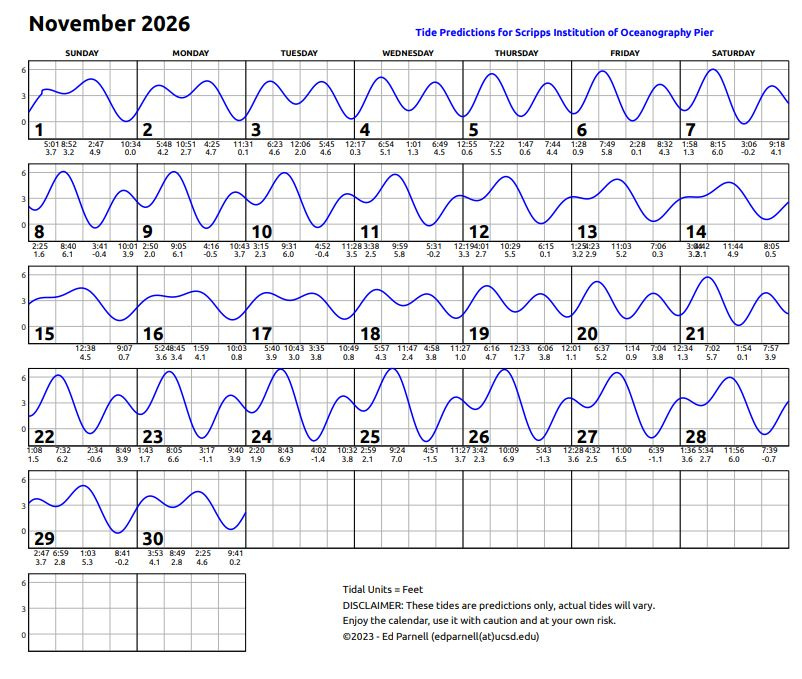
Image Courtesy of Scripps Institute.
So this—the tower, the paddleboard commute, the Coast Highway with a wet hem—this is just the opening act.
We heard “El Niño” and thought what we always think: big winter at Swami’s. The ocean heard “El Niño” and thought: Cardiff. The 101. Tuesday morning.
A series of overly dramatic AI-generated images emphasizing the problems.
We knew the ocean could put on a show—but we assumed our homes, beaches, and businesses were in the audience, not part of the performance.
Storm Surge? Warmer waters have resulted in more high winds and weather disturbances. Wind causes waves. Several storms generated strong storm surge.
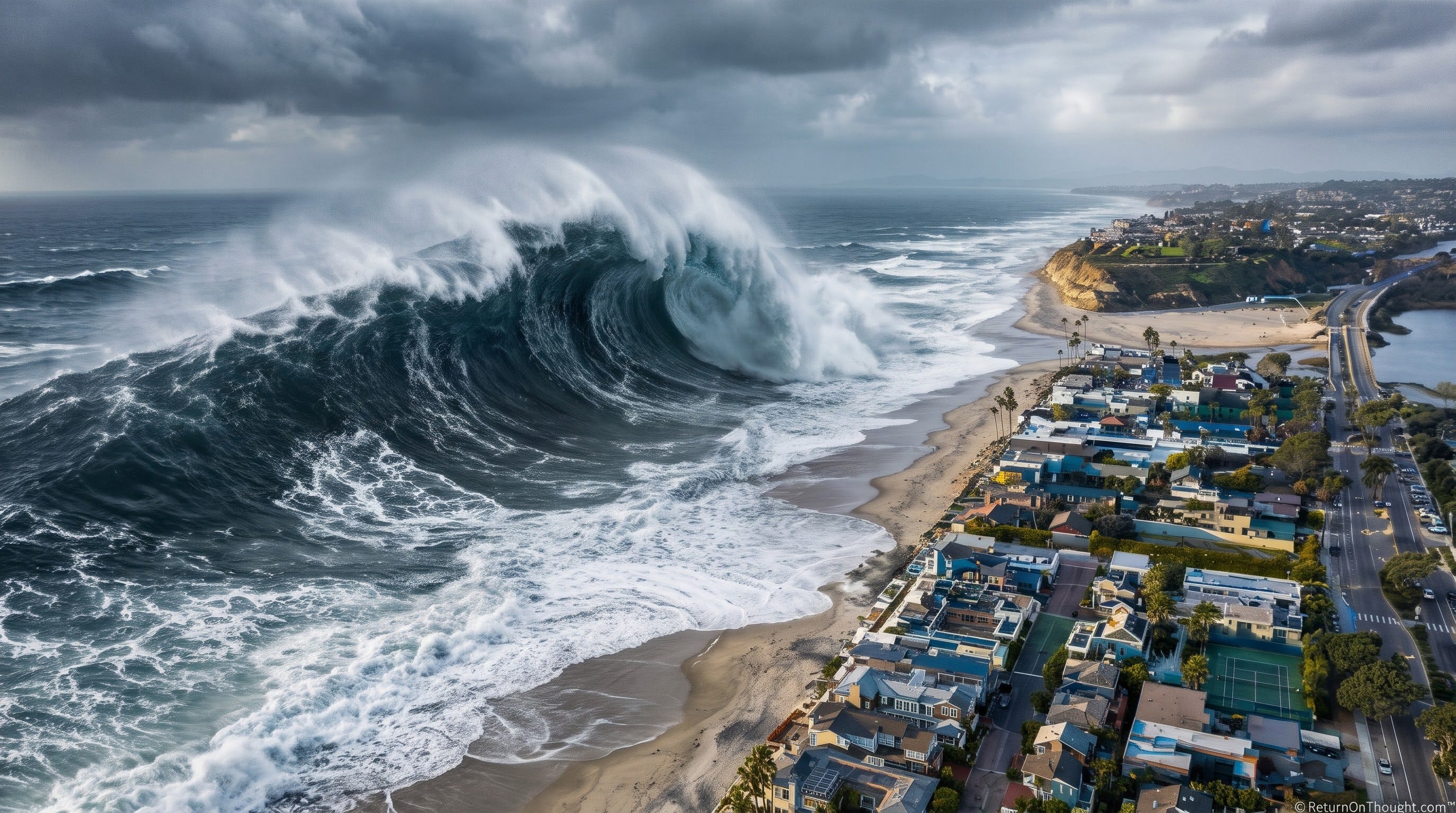
Overly-dramatic AI-generated image of Del Mar Beach. How some people may envision the elevated sea level, as if experiencing a singular large, tsunami-like (earthquake) wave. (Courtesy of © ReturnOnThought.com™)
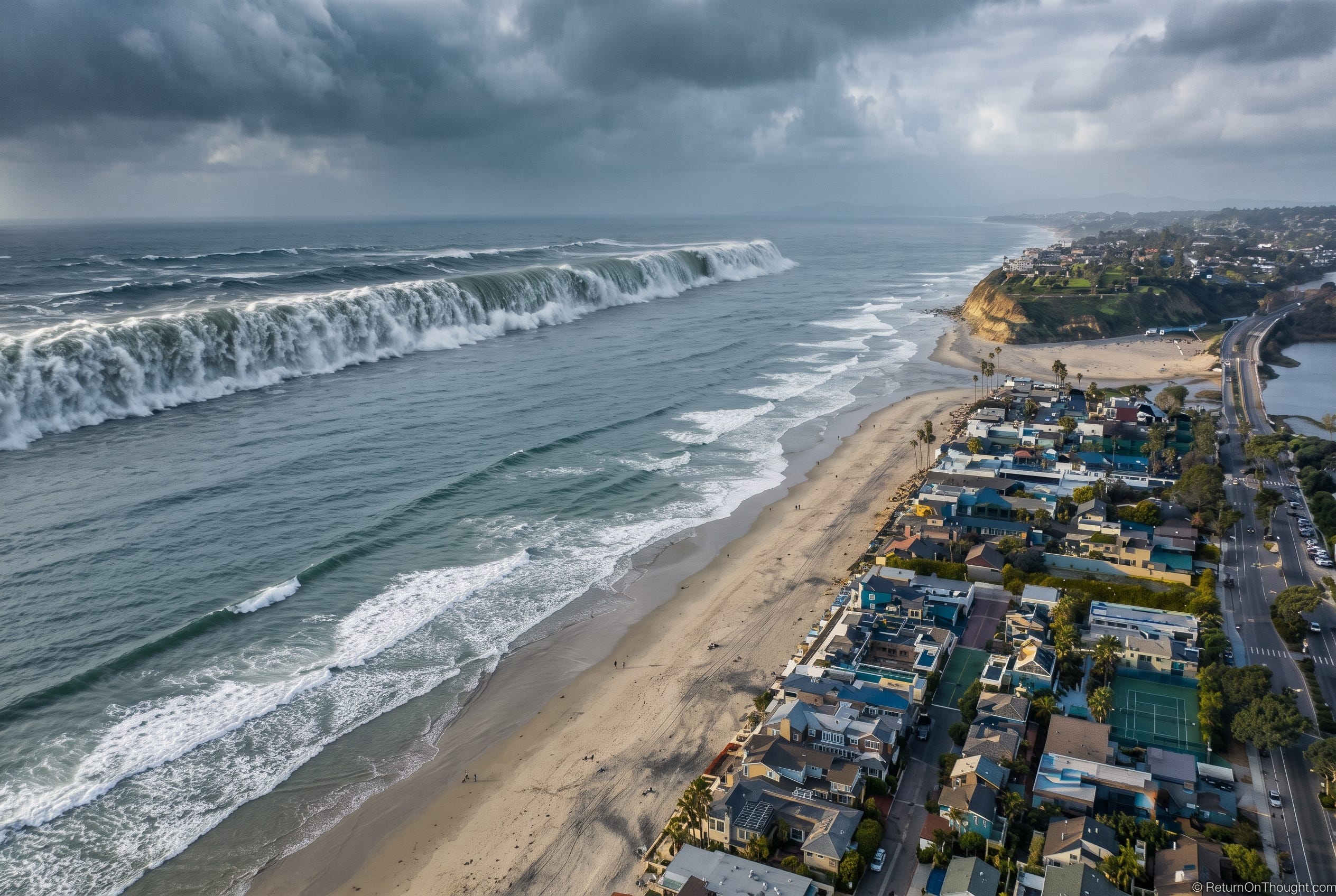
Overly-dramatic AI-generated image of Del Mar Beach. How some people may envision the elevated sea level, as if experiencing a Kelvin Wave. (Courtesy of © ReturnOnThought.com™)
How Can These Factors Impact Your Favorite Beach? Let’s do a surf check drive.
Black’s: Three hundred feet above sea level. The elevation provides the alleged ‘swimsuit optional’ beach with privacy. At least at low tide.
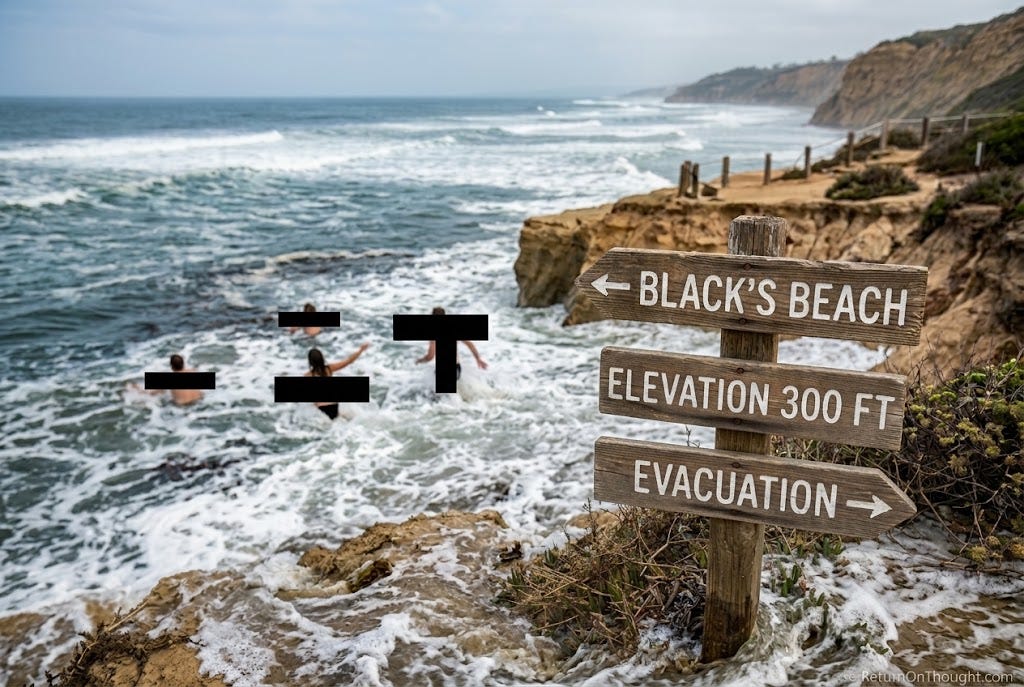
Overly-dramatic AI-generated image of Black’s Beach experiencing a 300-foot rise in sea level. (Courtesy of © ReturnOnThought.com™)
Del Mar: If the tide gets higher, maybe the race track gains an additional feature.
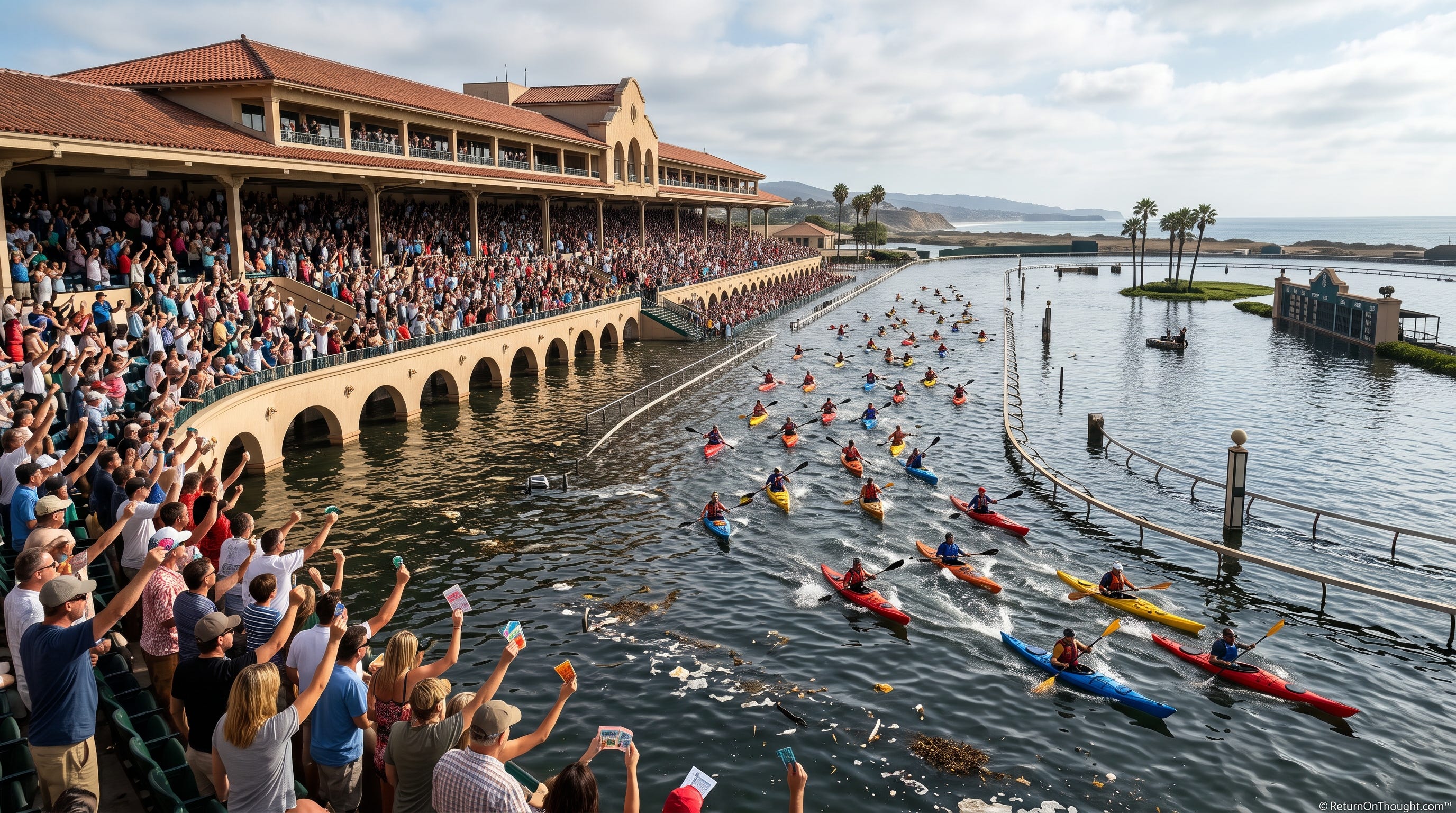
Overly-dramatic AI-generated image of the Del Mar Race Track, under new ownership.
Cardiff: The Cardiff Kook adapts easily and immediately to any situation.
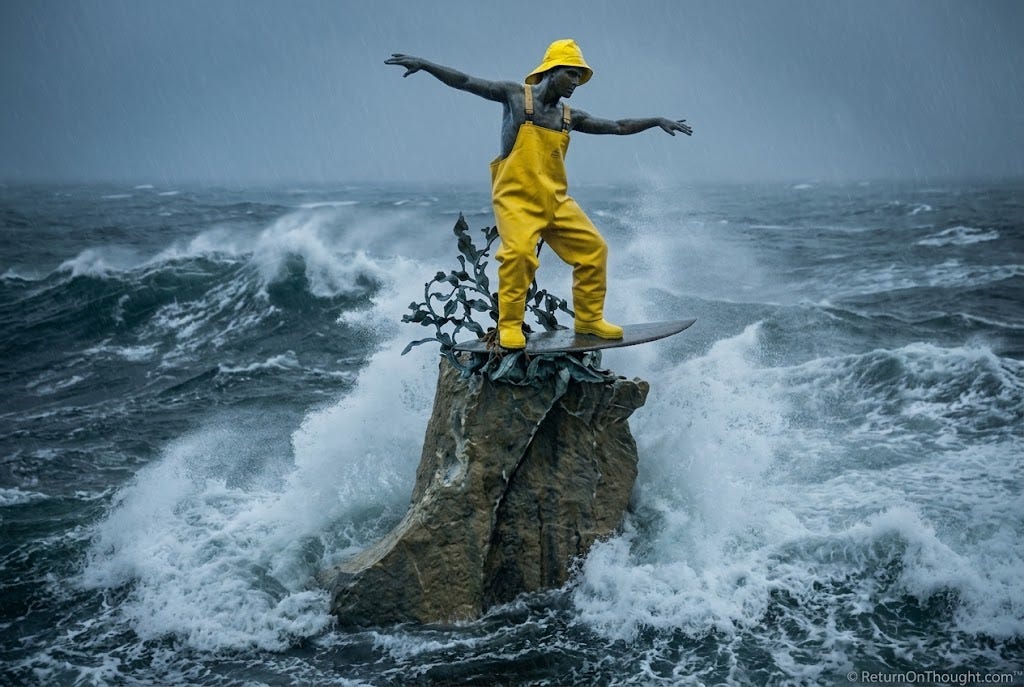
Overly-dramatic AI-generated image of the Cardiff Kook, doing what he does best, adjusting with the headlines. (Courtesy of © ReturnOnThought.com™)
Beacons: Maybe it’s time to add arm floaties to the lifeguard towers.
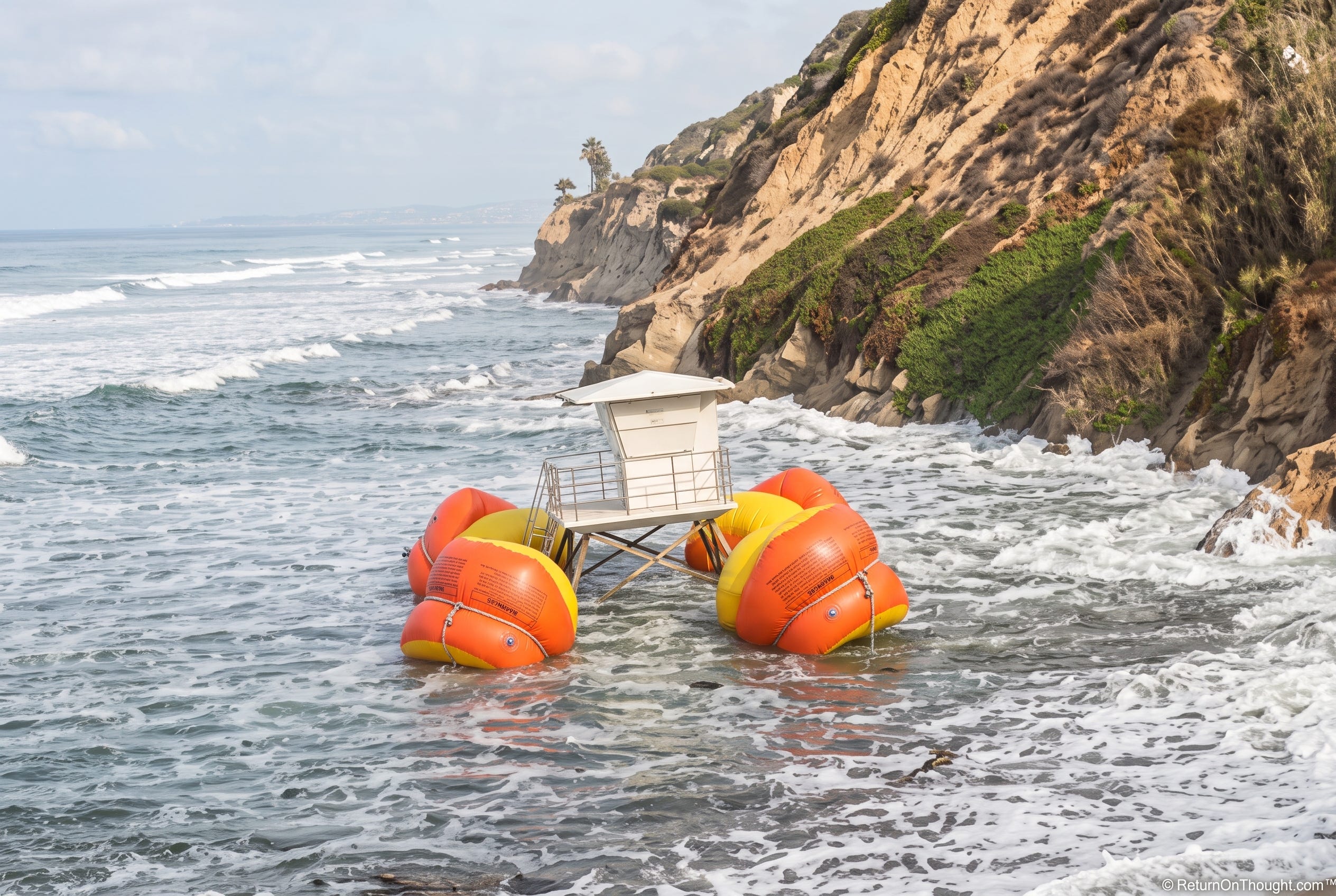
Overly-dramatic AI-generated image of Beacon’s Beach saving a lifeguard tower. (Courtesy of © ReturnOnThought.com™)
What about inland?
Congratulations, Poway, Rancho Santa Fe, And Vista - You Are The New Oceanfront: Relax. Rancho Santa Fe is 250 feet of eucalyptus and net worth. Your waterfront status remains what it has always been: a state of mind with a gate.
Vista is about 330 feet above sea level. Poway is around 500 feet up.
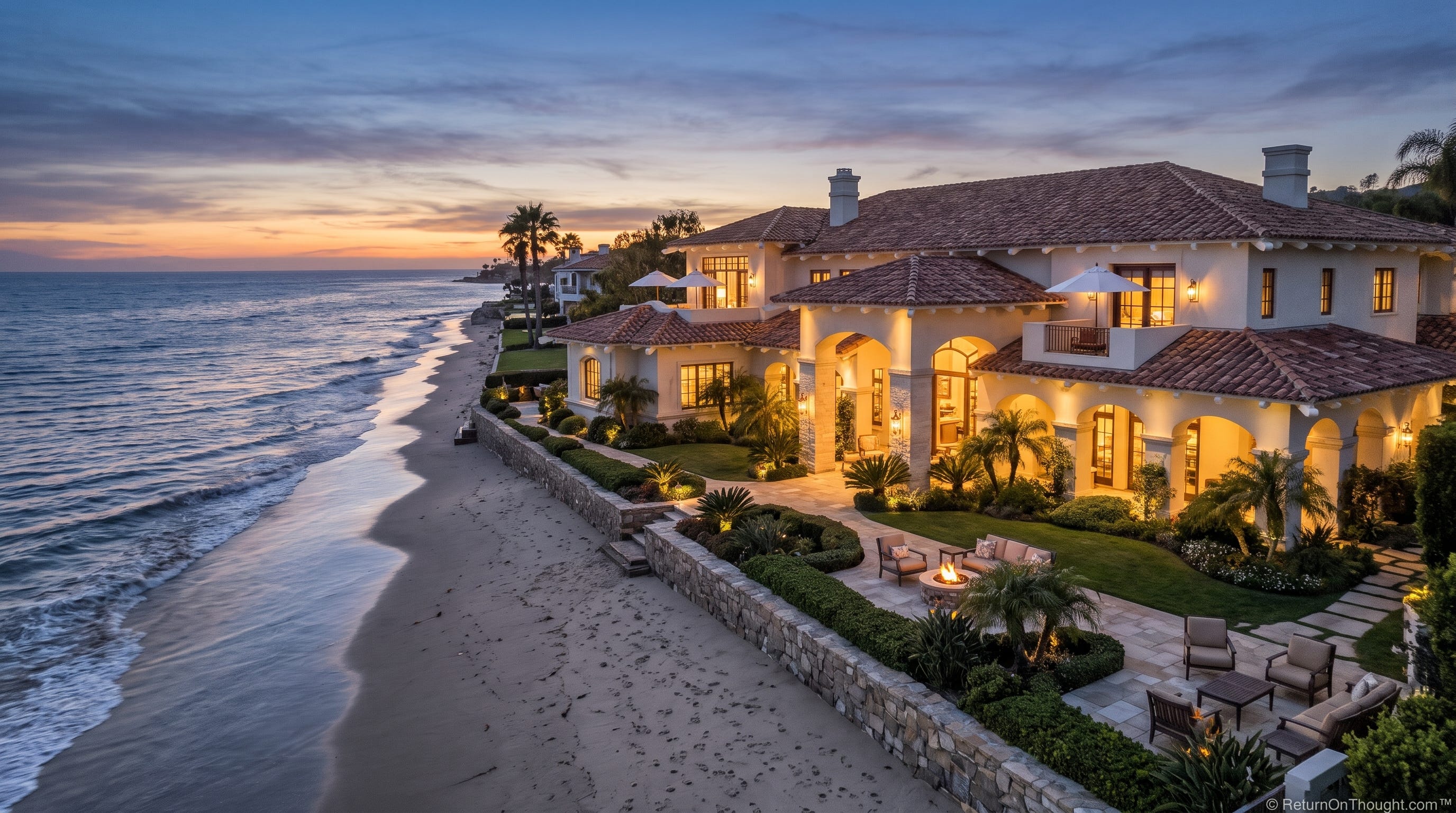
Overly-dramatic AI-generated image of inland Rancho Santa Fe Imagined As Waterfront. (Courtesy of © ReturnOnThought.com™)
At least you have a few more years before you experience your own waves.
Sink Or Float? A rising tide lifts what floats and sinks what’s fixed. Homes and businesses on the coast… sink.
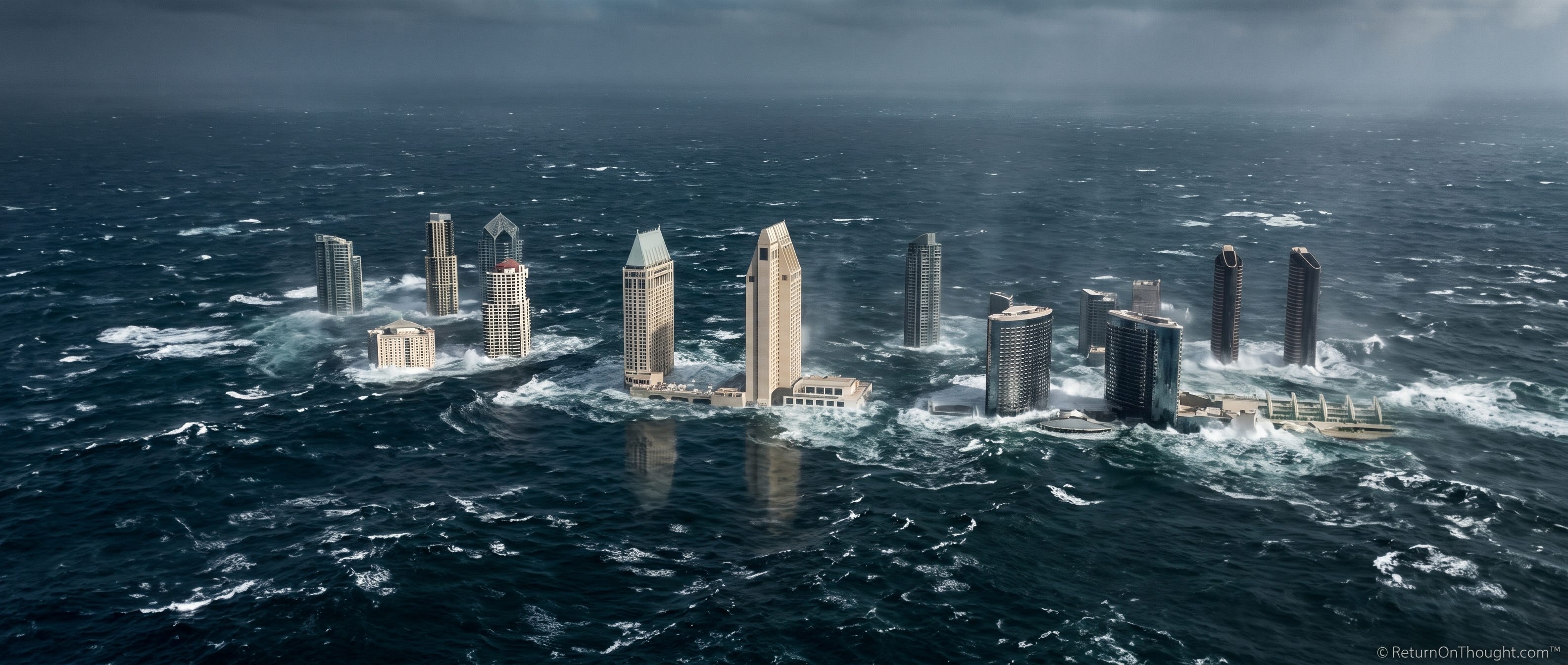
Overly-dramatic AI-generated image of downtown San Diego from a large Kelvin Wave. (Courtesy of © ReturnOnThought.com™)
Your Thoughts May Vary: Return On Thought welcomes your constructive comments and invites you to share your perspectives and experiences. Together, we can all refine our understanding and application of these concepts.
Disclaimer: Click here for our Disclosures, Disavowals, And Declarations (aka - I told you so).