

Facts say. Evidence shows. Story sparks.

What If… connection wasn’t the story you tell? What If… connection isn’t what you show? What If… connection is the Spark they feel?
Most persuasion fails not because the claim was wrong, but because the other person was never allowed to touch it. The proof gets stronger the moment you let go of it.
Year One - The Say
The large, curved pane of glass landed on the table with a dead, clean sound.
Cold. Clear. Waiting.
Needed/Not Needed: It was the 1920s. The product was new, and it was needed — a safer windshield, an improvement on something every car already had. Nobody was asking for it. That was the problem.
The Reluctant Buyer: Across the table sat the man who had heard every pitch, seen every chart, and learned — no, skilled — at letting enthusiasm die against the wall without leaving a mark.
The Buyer Was The Gatekeeper: The decision-making was in this room. And the gatekeeper does. He leaned back. Waited to be convinced.
The salesman did what most people do when they want to persuade. He explained. He pointed at the glass and said, "This glass is safer. It will not shatter into a thousand pieces when it breaks."
Once the buyer believed, sales would follow.
That was Say.
The New Product: It was not exciting. But it was needed. It was a new improvement on an existing, needed product.
The Salesman: At first, he did what most people do when they want to persuade. He explained. He described the windshield. He named the safety benefit. He gave them the data.
A Fact Can Be Heard: The salesman pointed and proudly said, “This glass is safer. It will not shatter into 1000 pieces when broken.”
The Buyer heard the benefit and bought the new safety windshield glass.
He knew thousands of cars would have safer, laminated windshields.
The salesman was good at Saying, and he became the salesman of the year.
That was Say. The Saying was the transactional step.
Year Two - The Show
The next year the salesman entered the same office, placed the windshield on the same table, and said the same words. Then he did something new. He wrapped the glass in a blanket.
He took out a heavy steel hammer.
The Buyer Wasn’t Ready: The salesman struck.
Crack.
Not the sound of failure. He struck again.
Crack.
He drew back the blanket. The glass was broken — a web of lines — and still connected. Nothing on the floor.
He did not have to say the buyer was amazed. He did not have to say the buyer felt safe. He did not have to say the demonstration was powerful.
The Buyer Saw The Proof: The action and the result let the buyer arrive there on his own. The eyes believed.
The salesman with the broken windshield became salesman of the year again.
Something important had changed state. The claim was no longer a thing the buyer was asked to accept. It was evidence he had watched. The feeling had arrived — the buyer already believed the glass was safe.
But notice who did the swinging. The salesman staged the test. The buyer reached the verdict.
The salesman still held the hammer. The buyer, for the first time, held the conclusion.
That was Show. The Showing was the transformational step. Proof had arrived.
The salesman was good at Showing, and he became the salesman of the year, again.
Year Three - The Spark
Showing - Proof Had Arrived: Ownership had not, yet... The salesman needed a Spark.
For the third year the salesman wondered how to go beyond saying, and beyond showing. He no longer needed a better explanation. He no longer needed a louder demonstration. He needed to stop carrying the proof.
Don’t Say, Don’t Show: The salesman entered the office. He placed the windshield on the table. He wrapped it in the blanket. He raised the hammer over his head…
The Windshield He Didn’t Break: — and stopped.
He handed the buyer the hammer and said, “You break it.”
The buyer was caught off guard. He was not used to participating in a pitch. He was no longer listening to a claim. He was testing one.
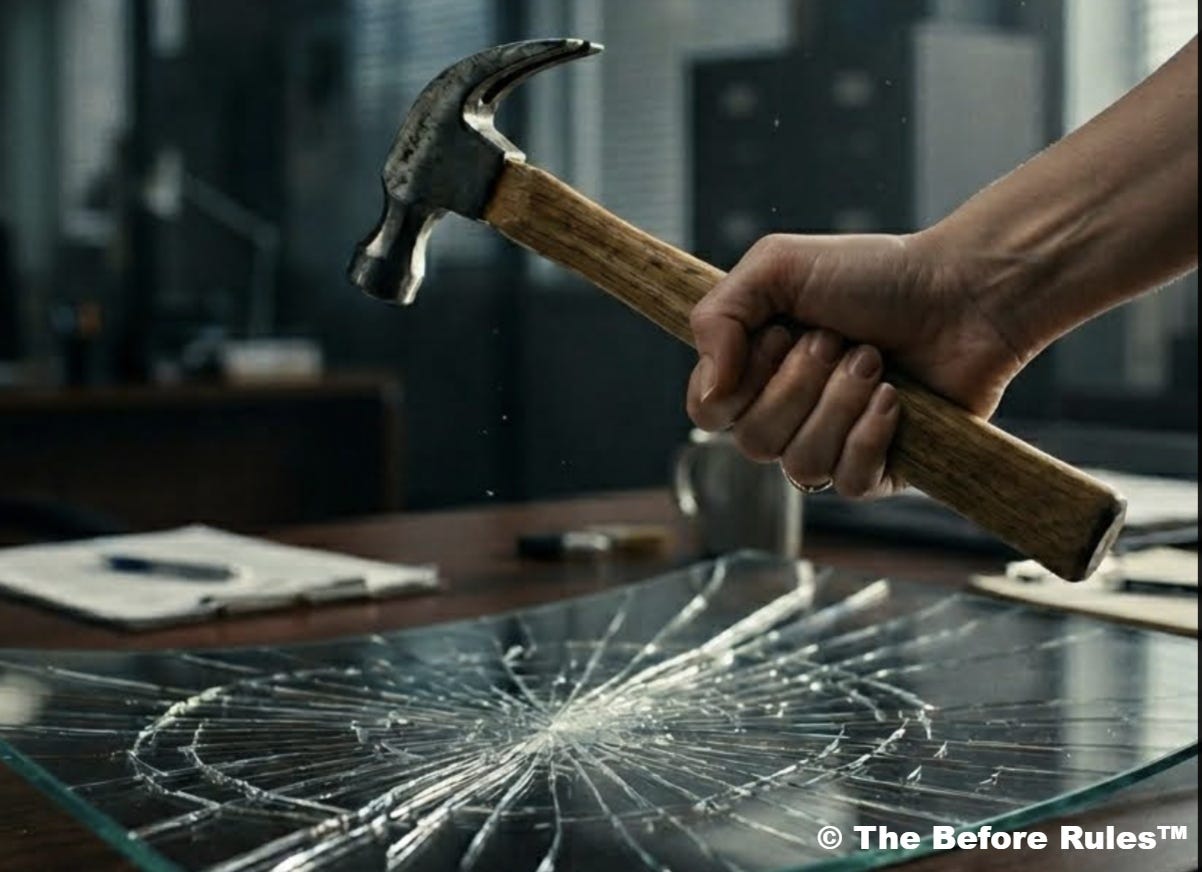
He took the weight. The wrist tightened. The room went quiet. Then the swing.
Crack.
Not the sound of failure. He studied the safety glass lines. Then he lifted the hammer and swung again, without being asked.
Crack.
The First Swing Was Invited. The Second Was Chosen. The buyer smiled. So did the salesman.
Say Transfers Language. Show Transfers Evidence. Spark Transfers Agency: The windshield did not sell when it survived the hammer. It had survived the hammer a year earlier. It sold when the buyer swung it — when the proof happened through him.
The hammer did not conquer his resistance. It gave his doubt a fair test, so he could decide.
The Glass Broke Twice. The Distance Broke Once: The proof happened through him, so the story stayed with him.
The buyer placed the order.
At the door, the salesman stopped, turned, and walked back. He handed the buyer the hammer a second time and said, “You keep it. It’s your story now.”
The buyer thought of the hammer as a souvenir. The salesman knew it was the receipt.
Look closely: the order was the outcome. It was not the proof of Spark. A buyer could test the glass, own the evidence, and still decide not to buy. Spark is not measured by agreement. It is measured by whether the judgment has become his.
That was Spark. Spark begins where showing ends.
The Sparking was the transcendent step. The buyer delivered proof to himself.
Here is the whole sequence in three sentences.
In Say, the salesman owns the hammer and the conclusion. In Show, the salesman owns the hammer and the buyer owns the conclusion. In Spark, the buyer owns both.
So, How Can You Apply This? A say enters the ear. A truth enters the eye. A Spark enters life.
That Is Your Frame - Give Your Buyer Your Hammer: Say gives the conclusion. Show lets the buyer reach it. Spark lets the buyer own how they arrive.
Ask three questions, in order.
Say: What is the simplest claim the person must understand?
Show: What evidence can they witness that changes their relationship to the claim — so the feeling arrives without my naming it?
Spark: What can I leave open, so the proof happens through them and the verdict is theirs to keep?
Then the fourth, which tells you whether it worked: what could survive, remain usable, or be retold without me in the room?
Ask Yourself, “Who Was Holding The Hammer?” Think of the last time you needed someone to believe you — a customer, a teenager, a board, a friend who was about to make a mistake.
Which year were you in?
Did you explain? Did you demonstrate? Or did you stop, mid-swing, and hand it over?
I can’t answer that for you. That’s the point. Whoever was holding the hammer at the end of that conversation is who owns the story now.
The salesman could stage the test. He could not own the verdict.
A Spark lights the search. It does not choose the crossing.
Do not fill the space where the other person must stand.
The Proof Gets Stronger When You Stop Carrying It: When the hammer changes hands, the story changes owners.
Subscribe and select the ‘No Pledge’ option to enjoy our next essay, Spark Before Life.
Sing-Alongs Welcomed: The essay provides a framework for your mind. This video (4:05) gives your body the beat. This hammer gives your story its Spark.
Everything you need to (know) hear about Say, Show, Spark…
Say, Show, Spark - The Music
AI-Generated Music © The Before Rules™
You’ve Read The Book, Now See The Movie:
Say, Show, Spark - The Movie
Original Video Courtesy of © The Before Rules™
Say can be repeated. Show can be remembered. Spark can be lived.
Your Thoughts May Vary: Thought Improvement welcomes your constructive comments and invites you to share your perspectives and experiences. Together, we can all refine our understanding and application of these concepts.
Just What Are Before Rules? “Before Rules” are three-word sequence tools—simple, repeatable patterns that clarify what must come first, so outcomes can be achieved. Here are a few examples:
There Before Here: What can a chocolate bar teach you about your work?
Say Before Show. Show Before Spark: How To Connect With People: When The Hammer Changes Hands, The Story Changes Owners.
Effective Before Efficient: A story about two AI models. One model is concise; the other, ‘does the right thing.’ Which is better for you?
Simple Before Complex: What isn’t simple becomes complex. Truth gets buried one syllable at a time.
Verify Before Trust: How to make ‘your’ AI more trustworthy. A script for you to copy.
Floor Before Ceiling: How does the ratchet effect not only save us, but improve us?
Decision Before Choice: Why choices are loud, but decisions are quiet. A true story - ‘Eddie would go.’ The man came first. The sticker came later.
The Before Rules are three-word systems for achieving real outcomes by putting the right thing first. Built on the sequence Here | Before | There, they clarify what must come first so progress becomes actionable, repeatable, and real. Examples include: Deposits Before Withdrawals, Through Before To, and Obstacle Before Opportunity.
Before Rules turn wisdom into action by making progress clearer, repeatable, and real.
One more important distinction regarding laws and rules.
Before Rules vs. Laws: Laws are written for you. Rules are decided by you.
Your Thoughts May Vary: The Before Rules welcomes your constructive comments and invites you to share your perspectives and experiences. Together, we can all refine our understanding and application of these concepts.
Disclaimer: Click here for our Disclosures, Disavowals, And Declarations (aka - I told you so).