

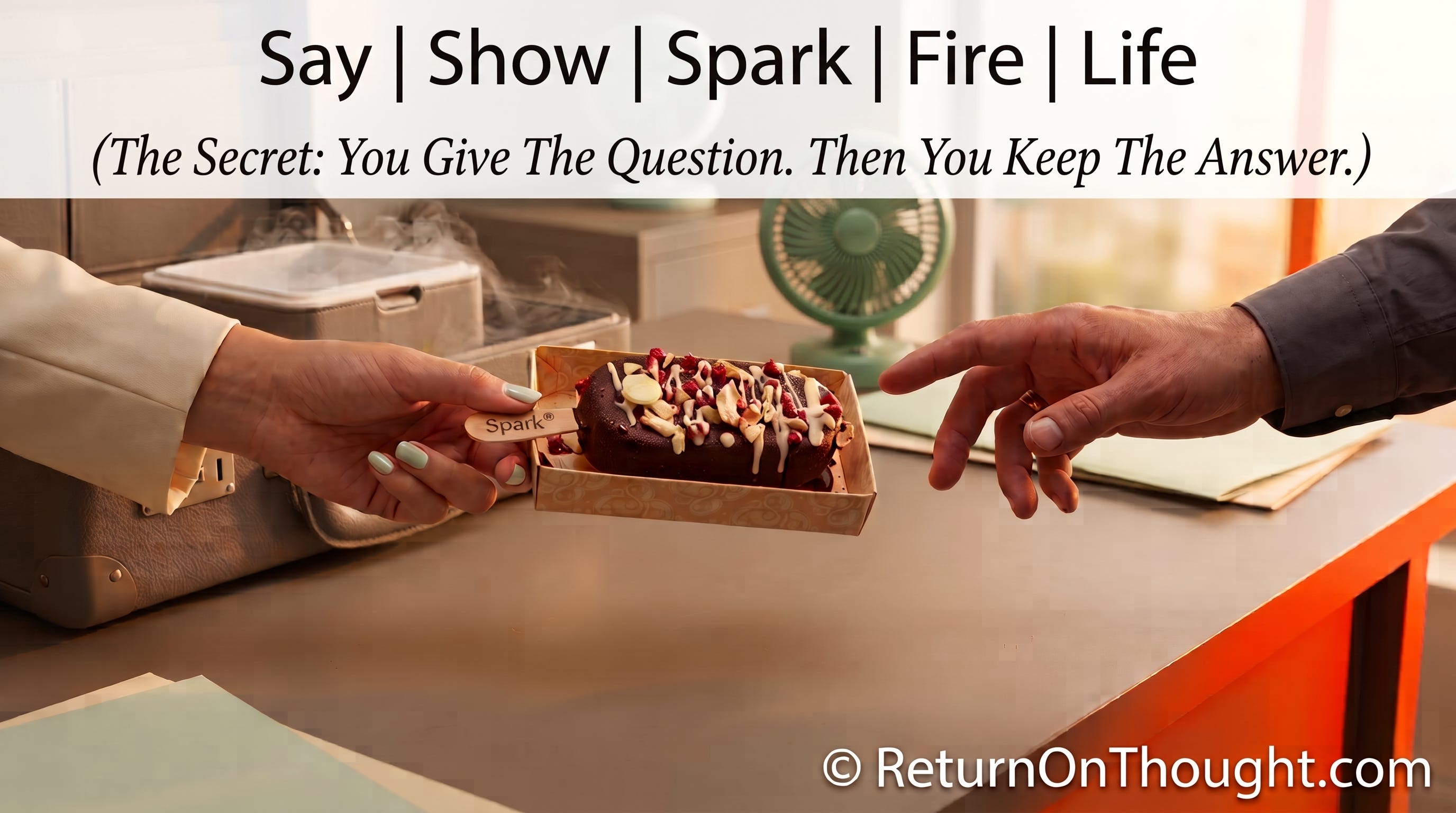
Give a product or service, and you have a prospect; give a question, and you have a buyer.
What If? What if the most persuasive salesperson in the room isn’t you? What if you could transform your customer into your salesperson?
She Was Ready For Her New Job: She had just arrived from Seattle to become the regional sales rep for a boutique ice cream company.
But Not Ready For The New City: It was the kind of Atlanta August where the shade was a rumor. Ninety-four by ten in the morning, air you had to push through, the asphalt in the grocery lot soft enough to take her heel print.
Good weather for selling ice cream—terrible weather for carrying it.
But she knew the heat that melts the bar is the heat that sells it.
She had lined up three small regional grocery stores to present their new product - an organic ice cream bar.
The company was small, but committed to providing quality, organic ice cream products, including a new organic bar they believed in.
The Say (First Presentation): She was excited to ‘say’ there was an introductory 40% off on the ‘brand new ice cream bar.’
The buyer sat across the desk with a small fan atop a filing cabinet, blowing air as hard as it could. The cabinet was already full of other people’s ‘good ideas’ that weren’t so good for the buyer.
“New organic bar. Launch pricing.” She walked her down the numbers. Here was the product. Here was the price. Here was a reason to make room: local company, great product, special pricing.
We’ll Get Back To You: Nothing wrong with the meeting. A product has to make sense on paper before it earns a shelf.
The regional sales rep was disappointed, but tomorrow was another presentation. She would be better prepared.
The Show (Second Presentation): A different chain, a different purchasing manager. The rep was determined to improve upon the first presentation. She brought the special pricing sheet and added graphics, surely to show this buyer why to buy.
The Graphics - USDA Organic. Fair trade. Local Business: She mentioned the special pricing, then presented a series of graphics. Information on the local company and small farms behind the ingredients. She was convinced the graphic would sway the buyer: information on how the ice cream bar was 100% organic.
She handed the graphic to the buyer and let them pull it close. Now the rep’s claims had something to stand on. The buyer could trace a line to its source, question a supplier, push on a number without taking the salesman’s confidence as the answer.
That mattered. The wrapper would carry the dairy’s name, but the bar would sit in this chain’s freezer, and a disappointed customer would walk back through this chain’s doors.
The buyer smiled and said, “Nice. We’ll get back to you.”
The graphic had done its job. The rep hadn’t.
She was determined to do better for tomorrow’s meeting.
She just didn’t know how… yet.
But she did know to start her car early and turn the AC on high ten minutes before she got in.
The Spark (Third Presentation): The Atlanta midday was already stifling as she loaded her wheeled briefcase into her car.
She met with the potential client at 2 p.m. She was worried about what was inside the briefcase.
Hot Day, Cold Client: This buyer was tough. He acknowledged the rep with a nod. He was brief. Concise. A bit dismissive.
He looked as if a post-lunch energy crash had already consumed him.
He breathed in slowly and softly said, “OK, Let’s get on with it.”
The rep replied, “I could tell you about our special pricing.” She continued without pausing for air, “I could show you the organic certification, the fair-trade papers, how all the ingredients are locally sourced.”
The buyer looked down at his desk. He had heard all this before.
“But I won’t.” She reached into her rolling briefcase.
Inside, she opened a small cooler. Dry ice exhaled a wisp of fog. She had packed it at noon and checked it twice at red lights. Even in this air-conditioned room, the bar had maybe twenty minutes of useful life.
She lifted the ice cream bar out and presented it across the desk.
“Taste this. Let me know what you think.”
The bar was already sweating. And so was she.
He took it.
She Handed Him The Sample, But Not The Verdict: She waited. She watched. For the first time since she walked in, he made eye contact.
The Spark: The buyer bit; more than just the ice cream bar.
His eyebrows went up before his mouth could say anything.
But a bite and an expression are not a purchase order.
She Knew What To Ask Next: “What do you think?” This asks for his judgment, and judgment is the one thing a buyer cannot return.
The TV series Survivor host Jeff Probst famously says, “In this game, fire represents your life.” This applies in real life, too.
The spark that ignites the fire provides the life that sustains it.
Spark Before Fire: Say leads to Show. Show leads to Spark. A spark is momentary, but necessary.
Ignition: The spark has become a fire.
Fire Before Life: He replied, “Sure, we will run a test order in our main store.”
He paused, looked down at his desk, as if to hide behind it, and asked, “Umm, any more bars in your briefcase?”
The buyer had become the seller.
The pricing sheet was still in her briefcase. So were the graphics. She had earned the right to leave them there.
Her selling was over; his story had started.
The sales rep left with more than a sale. She left with knowledge: A discount changes the offer. A bite changes the encounter.
The Close She Didn’t Have To Close: She learned to give buyers the questions, but not the answers.
Say, Show, Spark, Fire: Your spark becomes their fire when the customer decides to carry the flame.
Just What Are Before Rules? Before Rules turn wisdom into action by making progress clearer, repeatable, and real. “Before Rules” are three-word sequence tools—simple, yet powerful, repeatable patterns that clarify what must come first, so outcomes can be achieved.
Before Rules vs. Laws: Laws are written for you. Rules are decided by you.
Here are a few examples:
There Before Here: What can a chocolate bar teach you about your work?
Say Before Show. Show Before Spark: How To Connect With People: When The Hammer Changes Hands, The Story Changes Owners.
Effective Before Efficient: A story about two AI models. One model is concise; the other ‘does the right thing.’ Which is better for you?
Simple Before Complex: What isn’t simple becomes complex. Truth gets buried one syllable at a time.
Verify Before Trust: How to make ‘your’ AI more trustworthy. A script for you to copy.
Decision Before Choice: Why choices are loud, but decisions are quiet. A true story - ‘Eddie would go.’ The man came first. The sticker came later.
Your Thoughts May Vary: Return On Thought welcomes your constructive comments and invites you to share your perspectives and experiences. Together, we can all refine our understanding and application of these concepts.
Disclaimer: Click here for our Disclosures, Disavowals, And Declarations (aka - I told you so).