

How to go beyond the Wisdom Of The Crowd.
Consider this true story…
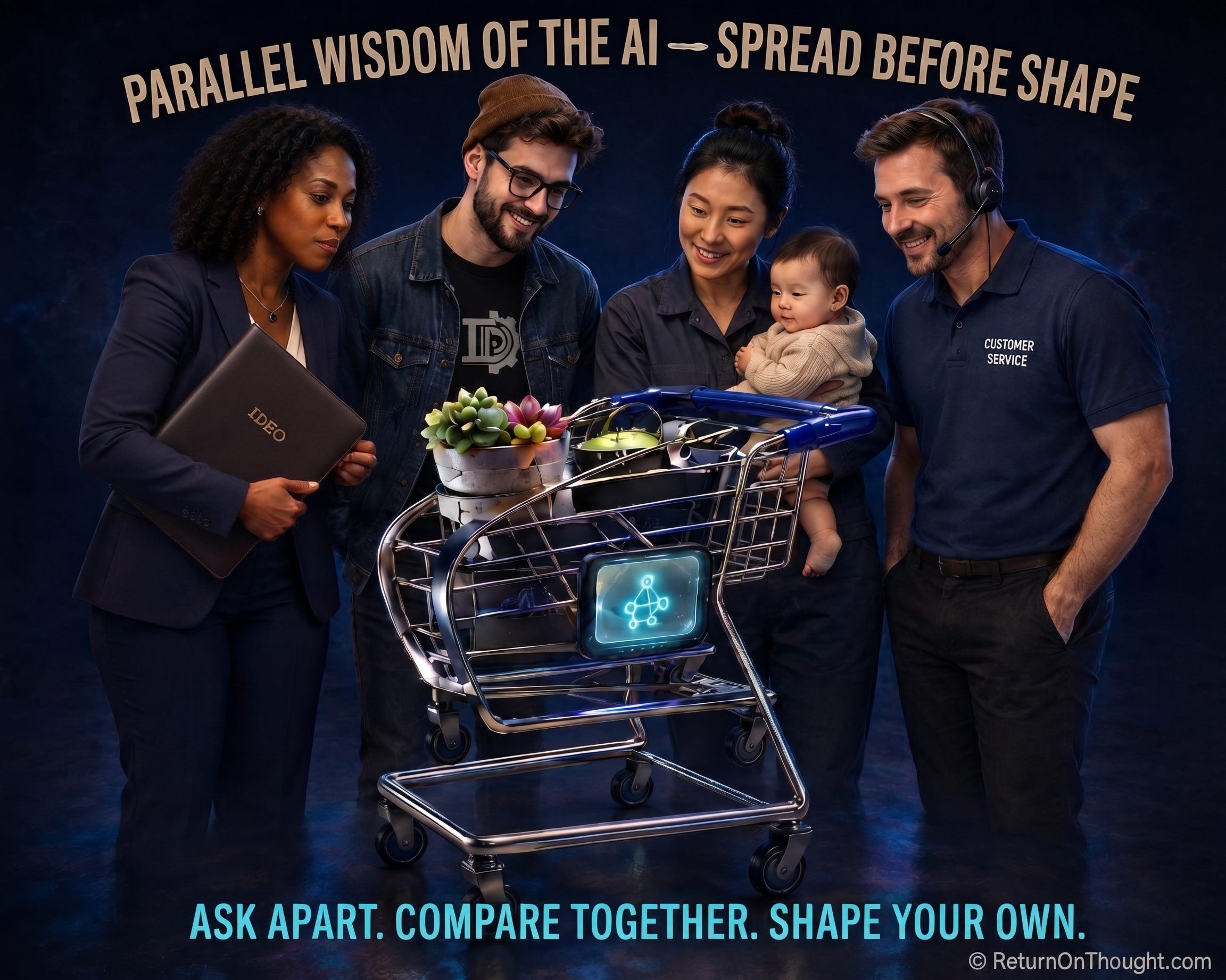
Five Days To Reinvent The Shopping Cart: In 1999, the ABC program Nightline handed the design firm IDEO a public challenge: redesign the ordinary supermarket shopping cart. On camera. In five days.
A Singular Focal Point: A normal organization would have delivered the assignment to its most senior designer and waited by their desk.
Not at IDEO.
The Spread — The Team Scattered, On Purpose: IDEO spread instead. An engineer led the team, but the room held people who had never designed a cart — a linguist, a psychologist, a marketer among them. One group watched shoppers navigate real aisles. Another talked with the people who repair carts and chase them out of parking lots. Others chased child safety, theft, maneuverability, cost — separate contacts with the same problem, none of them waiting for a master sketch to improve.
Child safety suggested one change. Theft suggested another. Maneuverability pointed somewhere else entirely.
The Compare — Great, Marginal, Discarded: Each group brought back what its contact with the problem had taught it. Some options were great, some were marginal, and some were discarded.
The Shape — Day Five: Slowly, the shopping cart came into focus. When the working model rolled out on the fifth day — an open frame, removable baskets, a redesigned child seat, wheels that let it turn in place — it carried something from every separate contact and copied none of them.
The Cart Rolls Out: IDEO did not find the perfect cart hiding inside one person’s first sketch. The team spread across the problem and came back with different pressures, different possibilities — and then someone had to shape what they brought back into a single cart. It was not averaged. It was assembled. That last act was not the crowd’s. It was the designer’s.
So, where did the shape of the cart originate? No one observation shaped the cart. The differences did.
The Blind Men And The Elephant Story — Run Backward: The six blind men who once touched a rope, a tree, a fan, a spear, a wall, a snake — and each walked away certain. Except this time, the pieces were assembled, and an elephant was built.
‘Rule Of Thought’ — Ideas: Not all ideas are equal. IDEO put ideas on the wall and voted not on the coolest but on cool and buildable.
Agreement Tells You What To Trust. Difference Tells You What To Build: Parallel Wisdom is not just noticing the similarities to accept, but the differences that must be included.
The machines supply the similarities and the differences. You supply the design.
Keep the answers different long enough to build what none of them could see alone.
A brief intermission… Where are we?
Macro View — Three Methods, One Family: These essays are numbered for the series, not as a mandatory operating order. When the route is uncertain, go wide before going deep.
Wisdom Of The Crowd — Design Before Decision: Offers the map — it chooses the conditions. Read more here.
You Are Here! Parallel Wisdom Of The AI (Wide) — Spread Before Shape: Chooses the road — it discovers routes when you don’t know where you’re going. You’re reading it.
Serial Wisdom Of The AI (Deep) — Reach Before Ratchet: Earns the miles — it improves the chosen route when you do know where you’re going. Read more here.
Ok, so you might be wondering how to apply this to your needs…
One Idea In Several Outfits: First, watch what most people do with four AI tabs. They ask ChatGPT for an idea. It gives a good one. Then they paste that idea into Claude, Gemini, and Grok and ask each to improve it. All four are now standing at the same sketch. You’ve created variation in wording, not variation in thought. This works with our Wisdom Of The AI Serial version, but not here in the parallel version.
The first answer became the design brief before it had earned the job. Ask every AI to improve your first good idea, and you may receive one idea wearing several outfits.
Micro View — Here’s The Sequence: Spread — ask several AIs apart, none hearing the others. Typically, I open tabs in some or all of these: ChatGPT, Copilot, Claude, Grok, Gemini, Perplexity, etc.
First, Ask Apart: The more important the outcome, the more inputs I employ.
Parallel Wisdom runs wide, and it runs separately. Separate conversations — tabs that can’t hear each other can’t copy each other, so collect every answer before you compare any. No preferred verdict smuggled into the question.
Second, Compare Together: Next, compare — mark what they share; hunt what only one saw.
Third, Shape: Build the answer from the similarities and the differences. Often, questions you could have or should have asked emerge.
Your turn, if you want… What question did you paste into four tabs last week, hoping they’d agree with you?
A Few Wisdom Of The AI Parallel Tips: Here is a synthesis of the successes and mistakes I have encountered:
Start with Fresh Chats — If you have a thread you are already building, you can input the results from the fresh chat as needed.
Ask The Same Question To All AIs — Put each AI on a level playing field at first.
Based Upon The Responses, Now Ask Different Questions — One AI may provide you with a perspective you failed to originally consider. The first round often returns something better than answers: a better question. You may find an erroneous assumption or a constraint you forgot, a goal hiding under the goal. This is the beginning of the spread improving you before you’ve shaped anything.
A Naming Example: Say you need a name for a new product. Run the vantages apart: one tab is asked what promise the name must carry — marketing’s question. One, what buyers will misunderstand — customer service’s. One, what has to stay simple on a label and in a database — operations’. One, what feeling a customer remembers a week later. And one tab generates names cold, seeing none of it. Then compare. The constraints that survive every vantage become the frame; the candidates that thread them become the shortlist; the choice is yours.
Build, Don’t Blend: Do not pour the responses into a blender and serve the average. Median mush is how the one idea that mattered gets sanded off. Mechanisms combine. Sentences merely average. Instead, ask: What did several windows independently support? What did only one notice? What assumption did almost all of them share? Which pieces can combine without losing their function — and what can now exist that no single response supplied? What everyone saw may be reliable. What only one saw may be valuable — or just wrong. The outlier is a clue, not a crown.
Consider A Homeowner’s Question: I spend two hours every weekend mowing a big lawn nobody uses. How do I get the time back?
Spread: Spread it, and the tabs come back with a faster mower, a robot mower, hiring someone, replacing it with native meadow, keeping only a small useful patch, or challenging why the lawn exists at all. Blend those, and you get a mediocre compromise.
Shape: Shape them, and you get: a small lawn near the house, the unused acreage converted to native planting, and a robot mowing only the strip that’s left. No answer had to win. Different answers became parts of a better one. The best answer may be the one none of the AIs gave you.
It’s Not The Outcome, It’s The Process: IDEO told Nightline it isn’t an expert in carts — or toothbrushes, or tractors. It’s expert in the process of designing them. That’s your job here too. The machines know the subject. You run the process. Or, as Nightline put it, “enlightened trial-and-error succeeds over the planning of the lone genius.”
‘Rule Of Thought’ — Golden Nuggets: I teach that every question has at least one golden nugget. And you keep asking the question, in different ways, until you find the golden nugget.
There’s Gold In Them ‘Thar Reaches’: If a Reach finds a nugget, I Reach again, because where there is one nugget there is usually more. I continue.
If a Reach fails to find a golden nugget, I change the query and Reach once more.
Sometimes the golden nugget is to stop what you are doing. If two well-aimed Reaches in a row produce no material gain, I generally stop.
However, if the query is critical or important, I may Reach a few more times with refined queries.
Reality gets the final vote.
Don’t Camp In The Spread: Parallel finds routes. One more observation from the Nightline/IDEO video… Nightline’s observers said the cart could still use refinement. That’s the point. Five days found the route. Refinement is a different method — that’s Serial. Once a spread has shown you the route worth taking, and you have explored the golden nuggets, stop spreading and hand it to the relay. Here’s is how to do that — Serial Wisdom Of The AI (Deep) — Reach Before Ratchet.
Shape begins when you and your team decide how the answers relate; if at all.
So, here we are…
Spread Before Shape: How To Go Wide For Creativity, Insight, And Innovation: Spread the question wide. Then shape the answer yourself. Reality gets the final vote.
Ask apart. Compare together. Shape your own.
Wide chooses the road. Deep earns the miles.
You’ve Read The Book, Now See The Movie: The IDEO story is documented in ABC Nightline’s “The Deep Dive,” aired February 9, 1999 — the challenge ran five days. Watch the original Nightline/IDEO project unfold.
Just What Are Before Rules? “Before Rules” are three-word sequence tools—simple, repeatable patterns that clarify what must come first, so outcomes can be achieved. Here are a few examples:
There Before Here: What can a chocolate bar teach you about your work?
Say Before Show. Show Before Spark: How To Connect With People: When The Hammer Changes Hands, The Story Changes Owners.
Effective Before Efficient: A story about two AI models. One model is concise; the other, ‘does the right thing.’ Which is better for you?
Simple Before Complex: What isn’t simple becomes complex. Truth gets buried one syllable at a time.
Verify Before Trust: How to make ‘your’ AI more trustworthy. A script for you to copy.
Floor Before Ceiling: How does the ratchet effect not only save us, but improve us?
Decision Before Choice: Why choices are loud, but decisions are quiet. A true story - ‘Eddie would go.’ The man came first. The sticker came later.
Your Thoughts May Vary: Return On Thought welcomes your constructive comments and invites you to share your perspectives and experiences. Together, we can all refine our understanding and application of these concepts.
Disclaimer: Click here for our Disclosures, Disavowals, And Declarations (aka - I told you so).
Don't Raise Your Ceiling, Raise Your Floor: Progress is not the peak you touch. It is the floor that rises after you touch it.
How to use AI to raise your floor without lowering your ceiling.
Reach produces. Receipt progresses. Ratchet performs.