

You are already aware of one ‘wisdom of the crowd’ example.
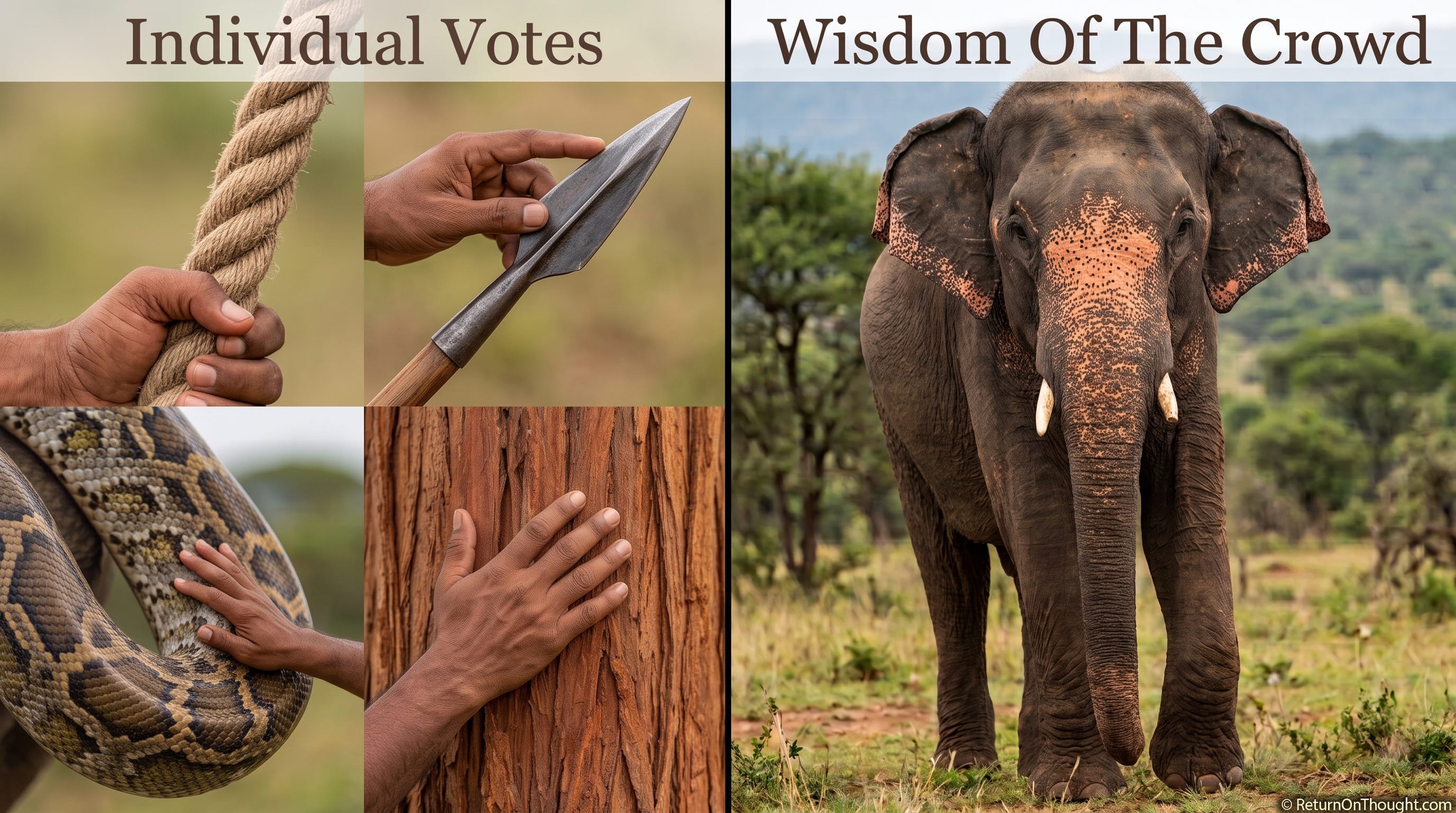
The Wisdom Of The Crowd Is Not Wise Because It Agrees.
The crowd is Wise Because It Disagrees.
Let’s explore the origin of the Wisdom Of The Crowd. It began with an ox…
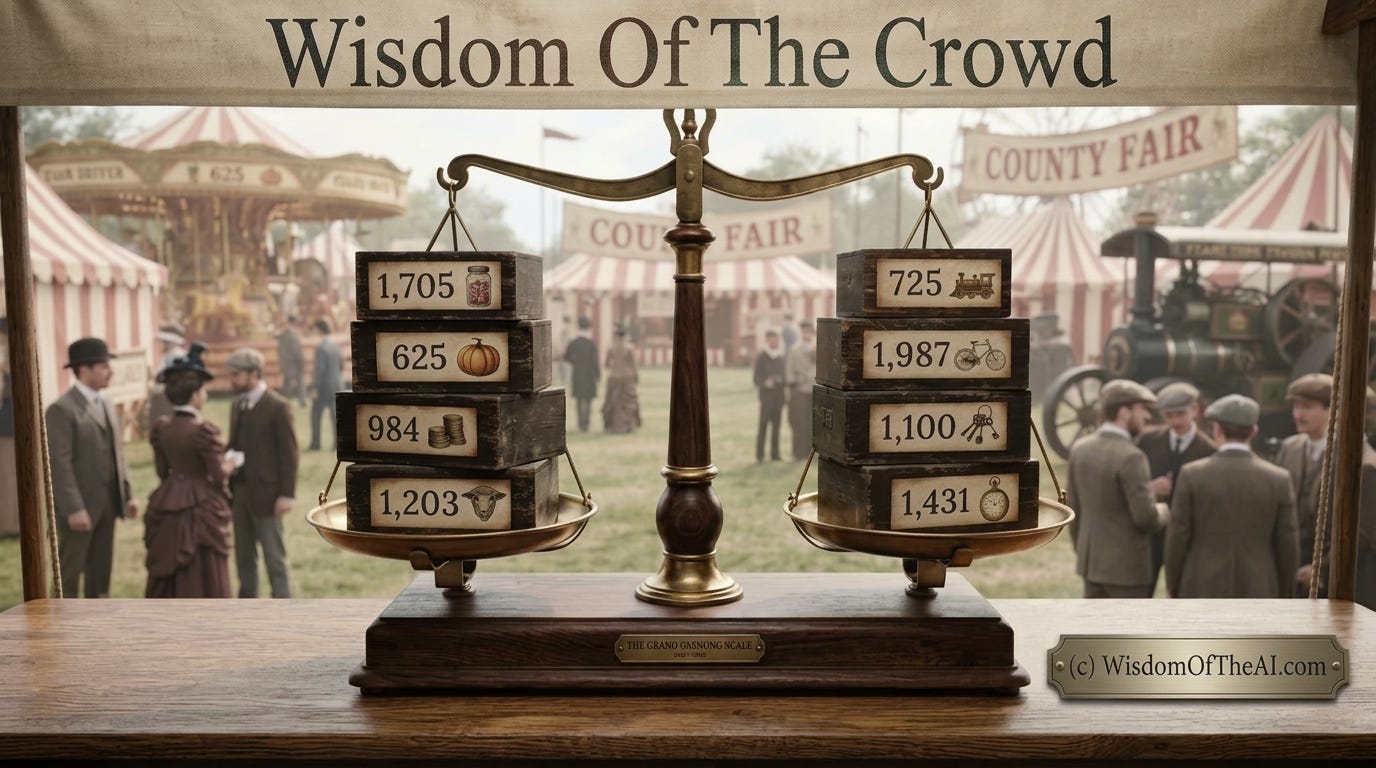
Statistically, Are People Dumb? It was the winter of 1906; statistician Francis Galton—eighty-four years old and a lifelong skeptic of ordinary judgment—was seeking to prove that ‘ordinary people’ lacked “the capacity for sound, complex judgment.”
He also was confident that intelligence was strictly hereditary.
He found the perfect test at a livestock fair: a contest to guess what a prize ox would weigh after slaughter.
Nearly eight hundred people paid sixpence each to enter — farmers, butchers, clerks, and laypeople who had never set foot on a pasture. Galton later noted the sixpence fee, along with a prize, did its quiet work: it made everyone try.
At First, He Was Right — The Mob Was Wrong: The guesses came in high, low, and wild. Thirteen defective cards were removed; 787 remained.
The ox — Galton recorded — weighed 1,198 pounds. One person guessed 1,197 pounds. Close, but, as far as Galton knew, every person was wrong, often dramatically wrong.
Galton expected the crowd to be wrong, and, for the most part, the cards agreed with him. Then he did what statisticians do. He gathered every card and averaged the crowd.
1,197: He came to disprove the crowd, but his own arithmetic refused to cooperate.
The mob may have been wrong, but…
The Crowd Was A Genius — Together They Were Right: The ox — Galton recorded — weighed 1,198 pounds. The average of all 787 guesses was 1,197 pounds — one pound off.
A Typo (Matho?) — The Part Even Galton Never Learned: He went to his grave thinking the crowd had missed by a pound. When a statistician finally audited the original worksheets in 2014, the organizer’s letter showed the true weight: 1,197. Galton had mistakenly written 1,198 pounds.
The crowd hadn’t been close. The crowd had been perfect to the pound — and the man whose lifelong motto was “Whenever you can, count” miscopied the one number that proved it.
Wisdom Of The Crowd — Were Right, Twice: One person had guessed the correct weight, 1,197. And the crowd's average was also the correct weight: 1,197.
Exactly one ticket hit the weight. Seven hundred eighty-six missed.
The Wisdom Of The Crowd found the true weight, to the pound. Zero error.
The Truth Is Beneath The Disagreement: Here’s the part most people miss: nobody knew what anyone else had guessed. Nearly eight hundred private votes, wrong in eight hundred different directions, canceling into one startlingly good verdict.
The smartest thing a crowd ever did together was to disagree alone.
Two Wrongs Make A Right: Each guess was an isolated event. The optimist who guessed high canceled the pessimist who guessed low. The errors collided, neutralized, and collapsed into silence. What was left was signal.
A crowd is wise not because everyone is right, but because people are wrong in different ways. Under the right conditions, a crowd can absorb ignorance and error — and output wisdom.
What Made The Wisdom Of The Crowd Work? The averaging worked — every card counted the same — only because the guesses were independent. And nobody at that fair designed the independence. Separate strangers, private cards, no loud expert at the entry box: the conditions arrived free, by accident of format.
Galton Inherited These Conditions: The key was the independence of each vote. This was the ‘perfect condition’ for the Wisdom Of The Crowd to prevail.
How Does This Apply To Your AI Prompts And Queries? Galton’s crowd received its independent conditions by chance. You, as the AI user, must design them.
Your Four Tabs Never Get The Accident. Notice what changes here. Open ChatGPT, Claude, Gemini, and Grok, and you have a crowd with a problem the fairground never had: they’ve all read the same internet. They share sources, assumptions, and blind spots — and if one confident answer enters the room first, the rest start harmonizing to it. The first answer is one witness, not a verdict.
So with machines, counting breaks. Simple averaging rewards the echo. What replaces it is design: you decide what question gets asked before any answer is seen, which windows stay separate, what each voice is asked to carry, and what gets checked before anything gets believed.
Does This Make Sense? Independence creates signal. Do not count voices. Design the distance between them.
Don’t Be Lucky, Be Good. Sometimes you want an AI carrying the full history of your project — that’s the deep dive, and it’s Part 2 of this series. Sometimes you need a voice that knows nothing, so its read is genuinely fresh — that’s the wide spread.
Different Jobs, Different Designs: What you never want is the accident - contamination you didn’t choose, agreement you didn’t earn.
Independence Before Agreement. That’s the first action inside the master rule. AIs can be wrong apart and right together.
Don’t ask one AI. Ask many. Ask the right way. Ask in the right order.
Design → Independence → Agreement → Judgment.
Let’s return to our Before Rule…
Design Before Decision: Disagreement is raw material. Design decides whether it becomes signal or noise.
Go Wide Or Go Deep. I’ve turned this into two step-by-step methods you can run tonight.
Wisdom of the AI — Spread Wide: Go wide when you need creativity, fresh angles, and blind spots exposed.
Wisdom of the AI — Dive Deep: Go deep when you need accuracy, thoroughness, and a document you can trust.
Both methods are free when you subscribe and select the ‘No Pledge’ option.
When Do You Stop Going Wide Or Diving Deep? Fortunately, one brake serves both - stop when a new query no longer changes the answer to what you’d do next.
The machines widen the room. You own the judgment.
Design the distance. Test the difference. Own the decision.
If you want the crowd to have wisdom, you have to design the conditions wisely.
Disagreement is not enough. The disagreements must remain independent long enough to provide information.
The First Most Important Lesson: Keep ideas apart until you are ready to make your decision.
A crowd becomes wise together only when uncrowded.
The Second Most Important Lesson: Don’t confuse the idea that all votes/guesses/ideas/findings are equal; they aren’t. Each response is simply a point to consider. When you mine for gold, you will find nuggets, flakes, empty pans, and even fool’s gold.
When To Research Wide, And When To Research Deep: Wide protects difference. Deep protects continuity. Verification protects truth.
The Purpose Of The Design Is Not More Answers. It Is Better Judgment: Go wide for possibility. Go deep for continuity. Verify for truth.
A brief intermission… Where are we?
Macro View — Three Methods, One Family: These essays are numbered for the series, not as a mandatory operating order. When the route is uncertain, go wide before going deep.
Wisdom Of The Crowd — Design Before Decision: Offers the map — it chooses the conditions. You are here, reading it.
Parallel Wisdom Of The AI (Wide) — Spread Before Shape: Chooses the road — it discovers routes when you don’t know where you’re going.
Serial Wisdom Of The AI (Deep) — Reach Before Ratchet: Earns the miles — it improves the chosen route when you do know where you’re going.
Just What Are Before Rules? “Before Rules” are three-word sequence tools—simple, repeatable patterns that clarify what must come first, so outcomes can be achieved. Here are a few examples:
There Before Here: What can a chocolate bar teach you about your work?
Say Before Show. Show Before Spark: How To Connect With People: When The Hammer Changes Hands, The Story Changes Owners.
Effective Before Efficient: A story about two AI models. One model is concise; the other, ‘does the right thing.’ Which is better for you?
Simple Before Complex: What isn’t simple becomes complex. Truth gets buried one syllable at a time.
Verify Before Trust: How to make ‘your’ AI more trustworthy. A script for you to copy.
Floor Before Ceiling: How does the ratchet effect not only save us, but improve us?
Decision Before Choice: Why choices are loud, but decisions are quiet. A true story - ‘Eddie would go.’ The man came first. The sticker came later.
Sing-Alongs Welcomed: The essay provides a framework for your mind. This short video gives your body the beat. You give the idea its spark.
Most everything you need to (know) hear.
AI-Generated Music © The Before Rules™
The Before Rules are three-word systems for achieving real outcomes by putting the right thing first. Built on the sequence Here | Before | There, they clarify what must come first so progress becomes actionable, repeatable, and real. Examples include: Deposits Before Withdrawals, Through Before To, and Obstacle Before Opportunity.
Before Rules turn wisdom into action by making progress clearer, repeatable, and real.
One more important distinction regarding laws and rules.
Before Rules vs. Laws: Laws are written for you. Rules are decided by you.
Your Thoughts May Vary: The Before Rules welcomes your constructive comments and invites you to share your perspectives and experiences. Together, we can all refine our understanding and application of these concepts.
Disclaimer: Click here for our Disclosures, Disavowals, And Declarations (aka - I told you so).
How To Use The Wisdom Of The Crowd To Achieve Wisdom Of The AI: The hardest part of designing this independence isn't setting up the separate windows—it is knowing when to stop asking. The temptation when running multiple AIs is to keep prompting until they finally agree with each other, which defeats the entire purpose of the wide spread. You do not stop when the crowd reaches consensus. You stop when a new query no longer changes the next decision you have to make.