

Mr. Right Or Mr. Right Now — Party Version: I think most of us have heard a variation of this story. Here is mine.
Freshman year, I had a girlfriend (Girlfriend? I know, I know, even I find that hard to believe) whose roommate—let’s call her Lisa—spent the semester searching for Mr. Right.
One night, after a few too many drinks, Lisa claimed she’d found him and was getting ready to leave the party with her “Mr. Right.”
My girlfriend warned Lisa, “He’s not Mr. Right. He’s Mr. Right Now. You may regret it.”
Lisa went home with him. She never heard from him again.
That tension between instant gratification and real value shows up everywhere—even in fantasy football. It’s just a game, but the lesson is real.
Mr. Right Or Mr. Right Now — Fantasy Football Version: Fantasy football runs on Mr. Right or Mr. Right Now every single week.
A Real-Life Example: ESPN Fantasy Football: My friend joined a fantasy football league at work. He was a casual football fan — but he was highly competitive.
He needed a receiver. His starter was injured and out for the year. My friend knew I liked numbers, statistics, and football.
He asked me the way you ask a friend with a car when you don’t have one. What he really meant was, can you do that AI-thingy and tell me who to grab for this weekend?
That’s what crisis mode asks: “What is the immediate fix?” The panic was Sunday. But the hole was the season.
Mr. Right Now: He showed me his ESPN app. “Highest projected points,” he said. “I need somebody for this week. With a lot of points. What do you think of this guy?”
The receiver was projected for 12 fantasy points—unusually high for a mid-season pickup. My friend had made his decision on the most obvious factor: projected points for this weekend.
I looked. The 12 points were real. The matchup was real. For this Sunday, he was right.
Then I said, “This Mr. Right Now can be right for this Sunday. He can also be wrong for your season.”
I opened the ESPN player tables. Names down the left. That was the easy part.
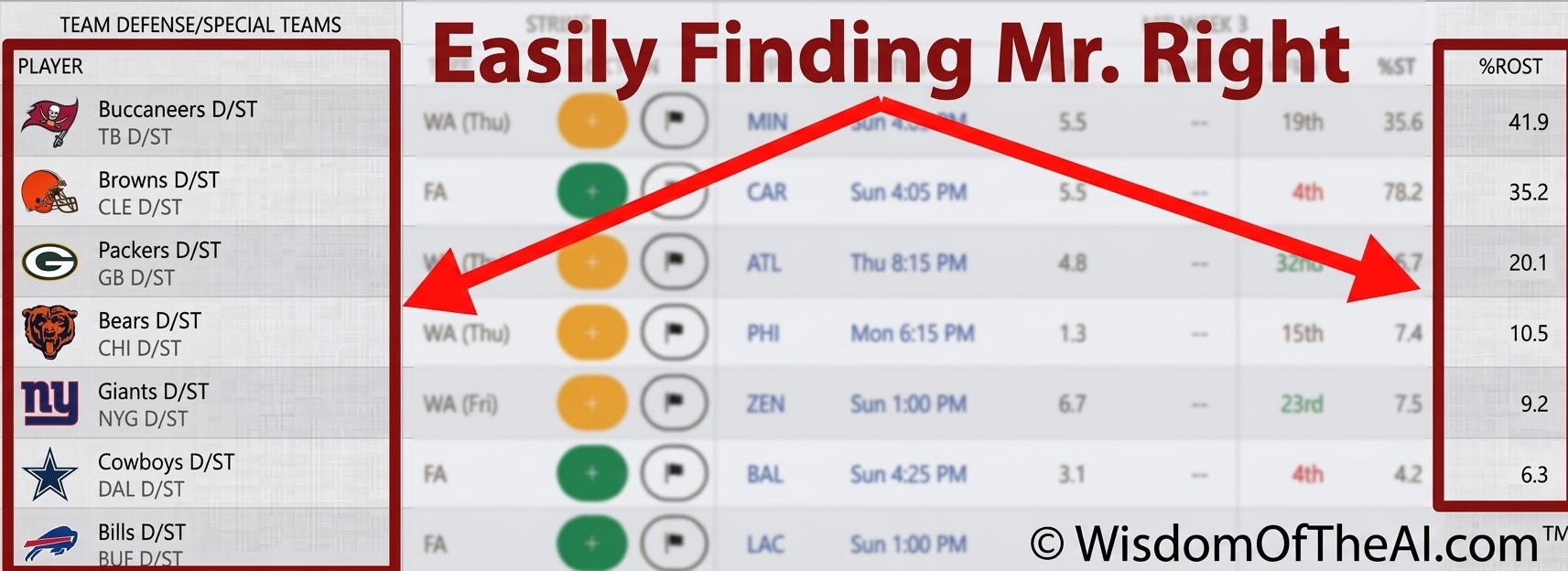
Abbreviations And Numbers, Numbers And Abbreviations, Everywhere: After the names came column after column of them — PROJ, SCORE, OPRK, %ST, %ROST, +/–. A lot of abbreviations. A lot of numbers.
My eyes glazed over just typing this. But what if we could just…
Find The One Right Column: I said, “Everyone looks at the PROJ column — the estimated points to be scored THIS weekend. That’s the wrong column for your problem.”
“If you fill your vacant roster spot with the highest score for this weekend, you are leaving the real vacancy open: the rest of your season.”
Finding Mr. Right: I said, “You don’t need Mr. Right Now. You need Mr. Right — the player who’s valuable for the entire season.”
“And here’s the good news. The analysis is already done for you. Right here. You don’t have to do a thing. Just sort. This column.”
Eliminate The Unnecessary: I said, “You don’t need all of this data. You just need one column.”
I pointed to a column with a heading that barely looked like a word — %ROST — and sorted it.
My friend said, “That column recommends a different player. A player who’s estimated to score fewer points (nine) this weekend than the one I want (12). Really?” He was politely implying I was a moron. (He usually was correct.)
Mr. Right Now Works For Right Now: My friend’s receiver was a backup — and the starting receiver on that team was out for the week. The backup was going to get a lot of playing time, and a lot of points. Once. This week only.
Wisdom Of The Crowd — %ROST: Instead of relying on one week’s projections, trust what millions of players are doing. If you use the Wisdom of the Crowd, you’ll improve your team all year, not just this Sunday.
%ROST means' percent rostered’—sounds complicated, but it is not. %ROST is the percentage of ESPN leagues where a player is on someone’s team. It doesn’t show who’s projected to score; it shows who the crowd has picked to keep. Last season, over 14 million people played ESPN fantasy football. If one player is rostered in 25% of leagues and another player is in 50%, managers believe the 50% player is worth holding more.
Why Does The Wisdom Of The Crowd Work? Because millions of people make decisions differently—some watch film, some follow the news, some trust the numbers. The variety helps balance out mistakes, so the crowd’s consensus is often reliable. I said, “They do the work for you. You just sort.”
Learn more about the science behind the Wisdom Of The Crowd.
Twelve Points Once, Or Nine Points Every Week: I sorted the %ROST column and said, “Here’s your answer. Your Mr. Right Now offers 12 fantasy points for Sunday. But he expires in seven days. After this week, the main receiver is back, and Mr. Right Now goes back to about 5 points a week.”
“Look here,” I pointed. “Mr. Right offers you about nine points a week. Every week. For the entire season.”
Twelve once, then five. Or nine, every Sunday until December. My friend did the math faster than I did.
The 12-point surge on Sunday felt like a win, but it bought ten weeks of mediocrity. It was classic short-term gain for long-term pain. In fantasy football, playing for the short-term game almost guarantees the long-term pain.
Wisdom Of The Crowd, Or Wisdom Of The Now? The two columns — this weekend’s points vs. %ROST — weren’t disagreeing about the same thing. They were answering different questions: Mr. Right, or Mr. Right Now?
Every ranking answers one question over one stretch of time. Find the stretch before you trust the rank.
The forecast was 12 points this weekend. The decision was more than just this weekend.
The Exception To The Rule — Your Judgment: One caution. Sometimes today really is the whole decision — a bye week, an injury, a one-week hole in your lineup. Then Mr. Right Now is exactly who you want, and the PROJ column is exactly the right column. The rule is match the stretch — not longer-always-wins.
My friend’s starter was gone for the year. That’s a Mr. Right problem. We stopped looking at Sunday’s number, and he got his receiver — one the crowd had been keeping, and the rest-of-season column liked. Whether it works, the season will tell us. That’s what seasons are for.
The forecast was for Sunday. The decision was for the season.
Knowledge comes from what you gather; wisdom comes from what you learn to ignore.
How Do You Apply The Mr. Right Now Vs. Mr. Right Lesson In Real Decisions? Here are four quick strategies:
1. Before You Select Anything, Ask: How long does this solution need to last? Am I just patching a hole for today, or building for the future?
2. With Quality, You Only Pay Once: Don’t get distracted by big, short-term numbers or promises — check if they match your real need.
3. Wisdom Of The Crowd: When in doubt, see what experienced people are doing. The crowd’s long-term choices are often wiser than this week’s headline.
Before Selecting A Number, Check The Date Attached To It: Does the date match your needs?
I keep thinking about my friend’s app. Small gray type across the top of the table: NFL WEEK 2. It had told us its limits before either of us sorted a thing. He’d looked straight past it to the big projected number, because it looked like an answer.
Ignore The Sizzle, Focus On The Steak: It is impressive to have columns and columns of detailed analytics. But not all information is equal. In our fantasy football example, just two columns offer the most value: Proj (estimated points this weekend) and %ROST (what percent of all other teams selected the player).
Then, you only have to decide (learn more about Decision Before Choice) between…
Mr. Right Now May Win The Week; But Mr. Right Wins The Season: Most of the time, it’s wiser to choose steady value over a flashy quick fix. But when the situation truly demands it—a one-week gap, an emergency — don’t be afraid to grab the short-term spark. The real skill is knowing which kind of problem you’re solving.
Your Thoughts May Vary: Return On Thought welcomes your constructive comments and invites you to share your perspectives and experiences. Together, we can all refine our understanding and application of these concepts.
Just What Are Before Rules? “Before Rules” are three-word sequence tools—simple, repeatable patterns that clarify what must come first, so outcomes can be achieved. Here are a few examples:
There Before Here: What can a chocolate bar teach you about your work?
Say Before Show. Show Before Spark: How To Connect With People: When The Hammer Changes Hands, The Story Changes Owners.
Effective Before Efficient: A story about two AI models. One model is concise; the other, ‘does the right thing.’ Which is better for you?
Simple Before Complex: What isn’t simple becomes complex. Truth gets buried one syllable at a time.
Verify Before Trust: How to make ‘your’ AI more trustworthy. A script for you to copy.
Disclaimer: Click here for our Disclosures, Disavowals, And Declarations (aka - I told you so).